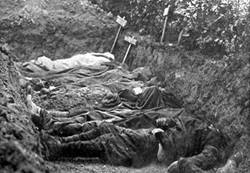
- Societies invent ideological concepts, elevate them to “absolutes”—and worship these ideas as the foundation of their cultures. But how do people persuade themselves that these social constructions are real or true?
- Franco Fornari states that war is the spectacular establishment of a general human situation whereby “death assumes absolute value.” The ideas for which we die have a right to truth because death becomes a "demonstrative process.”
- Beliefs become true or real when citizens (and enemies) die for them. Sacrificial death “gives witness” to the depth of devotion, the source of the truth, and the power of the idea.
- The nature of the idea, or belief, or entity for which people sacrifice their lives is fungible. The ideal might be called preserving the Union, France, the British Empire, Germany, the Emperor, Communism, Allah, a Tamil homeland, or “freedom and democracy.”
- The ideas or entities—the nature of the sacred ideal or object for which people die differs. However, the mechanism of validation is the same. The sacred object or ideal comes alive to the extent that human beings die and kill in its name.
- The concept of “killing” is subordinate to the concept of “dying.” The purpose of acts of “aggression” (killing in war, genocide, or terrorism) is to get others to die for the idea that is worshipped by one’s own group. One kills members of the other group so that they will die in the name of one’s own group’s sacred ideal (death to the non-believers).
Killing, Dying, and the Quest for Truth
(From co-Pilot)
Killing and dying have long been framed as ultimate tests of truth — not just in moral philosophy, but in cultural and political contexts where belief systems are at stake.
Koenigsberg’s “That for Which We Die Must Be True.” In warfare, Koenigsberg notes that killing and dying are not random; they are acts undertaken to validate an ideology. The sacrifice of soldiers’ bodies and lives is seen as proof that the cause is real. This is a “demonstrative process” — death becomes a confirmation of belief. The sheer scale and horror of war make it implausible that people would die for nothing, so the belief must be true.
|