| Death in war as a principle of verification ("The Law of Sacrifice") |
| Richard A. Koenigsberg |
|
|
|
"Science is organized around a limited number of concepts (or "laws") that account for everything we see in the world around us." (Hazen and Trefil, 2009).
"Newton developed compact laws that apply to an immense assortment of situations. His three Laws of Motion—like all fundamental laws that govern science—seem simple, almost simplistic. The deepest insights of the human mind often have this characteristic." (Hazen and Trefil, 2009). |
|
DEATH AS TRUTH
- Cultures invent ideological concepts, elevate them into "absolutes"—embraced as the essence of their societies. But how do people persuade themselves that these constructs are true or real?
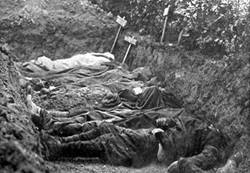
- Franco Fornari hypothesizes that war is the "spectacular establishment of a general human situation whereby death assumes absolute value." The ideas for which we die have a right to truth. Death functions as a "demonstrative process."
- Ideologies become real when people die for them. Death performs a "truth" function by "giving witness" to the depth of devotion. Death becomes a principle of verification—testifying to the reality of an idea.
- The nature of the ideas or beliefs or entities for which die is fungible. People have died in the name of "preserving the Union" or the British Empire or the German Reich or the Emperor (of Japan), for Communism, Allah, even for a "Tamil homeland" and of course r for "freedom and democracy."
- The nature of the ideal or object for which people die and kill is fungible but the mechanism for validating the idea is the same. A sacred object alive to the extent that people die or kill in its name. Dying and killing is not an anomalous event. War is necessary and required, forming the foundation of societies.
|
|
|