|
FOUNDATION FOR THE STUDY OF POLITICAL PSYCHOPATHOLOGY
Welcomes Professor James Tyner as researcher, author and collaborator. He's a geographer, but also an anthropologist and historian--one of the world's authorities on comparative genocide. In his paper (below), Tyner shows how--for the Nazis--the Holocaust and warfare were derivative. What was fundamental was Hitler's belief that the state had the right to decide who should live--and who should die.
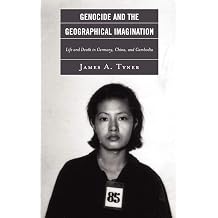
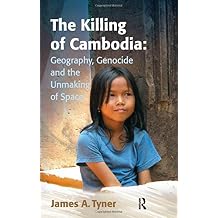
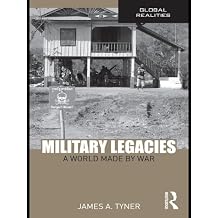
To the right-below are three of Tyner's seminal books. Please click through the links for additional details--and information on how to order.
Best regards,
Richard Koenigsberg, Director
Center for the Study for Political Psychopathology
PS: Scroll down to the bottom of the page for a photo of Tyner at work in his office--and a brief biographical sketch.
|
Sovereign Violence and Geographical Imaginations
The Holocaust, Richard Koenigsberg writes, evolved out of the killing of mental patients. He explains that the first mental patient was killed in August 1938; the Holocaust began in July 1941. Simply put, the notion of killing human beings—outside of war—transformed over time and over space.
For members of the Nazi Party and their followers, the thinking about exterminating human beings grew out of a philosophical treatise of ‘life unworthy of life’.
Notably though, this ontology of annihilation was predicated on a geographical imagination, that is, a particular will to space that provides a moral foundation for who is to inhabit a particular place and who is to be eliminated.
To that end, the Holocaust was the culmination of a state-centered geographical imagination decades in the making. Although ultimately directed primarily against ‘the Jew’, the Nazi state in effect assumed the right to eliminate those population that posed, from their vantage point, a threat to its existence.
Of particular importance was Adolf Jost’s 1895 essay Das Recht auf den Tod (“The Right to Die”). Jost argued that the right of life and death belonged to the state and, as such, that the state was well within its sovereign right to authorize the direct medical killing of people. Jost’s argument conformed with the broader geopolitical thinking of his day, namely the geographical imaginations of Friedrich Ratzel.
As Roberto Esposito explains, these ideas solidified the mindset that where the health of the political body as a whole is at stake, a life that doesn’t conform to those interests must be available for termination. To that end, as Robert Lifton writes, Jost’s position was that “the state must own death—must kill—in order to keep the social organism alive and well.”
Two decades later, a similar geographical imagination was forced by Alfred Hoche and Rudolf Binding with the publication of Die Freigabe der Vernichtung Lebensunwerten Lebens (“The Permission to Destroy Life Unworthy of Life”). In their advocation of eugenic practices, Hoche and Binding premised that the right to live must be earned and justified; those not capable of human feeling, described as “ballast lives” or “empty human husks” could have no sense of value of life; theirs is a life not worth living; destruction is not only tolerable, but humane. They argued that the state-sanctioned elimination of lives unworthy of life was a pragmatic policy—a rational solution to an immediate problem.
Hoche supported his argument with a calculated valuation of life. He claimed that “20-30 idiots with an average life expectancy of fifty represented ‘a massive capital in the form of foodstuffs, clothing and heating, which is being subtracted from the national product for entirely unproductive purposes.’” In other words, Hoche’s geographical imagination had an economic core—a biopolitical cost-benefit analysis that balanced the productivity of life against the expenditures required to support the lives of those unable to produce. Similar calculations were enacted by the Nazi state when the extermination of mentally and physically disabled people began. Surviving documents, for example, detailed that Nazi officials estimated that the “disinfection” of over 70,000 people resulted in a savings of over 245,000 Reichsmarks per day.
|
The sovereign right to own death, however, exceeded the financial health of the nation-state; indeed, a crucial component hinged on the idea of sacrifice. On this point, both Hoche and Binding made the connection between the state’s sovereign right to ask soldiers to sacrifice for their country—including the possibility of dying for one’s nation—and the practice of keeping (and paying for) the mentally disabled to be housed in asylums.
They explained:
If one thinks of a battlefield covered with thousands of dead youth and contrasts this with our institutions for the feebleminded with the solicitude for their living patients—then one would be deeply shocked by the glaring disjunction between the sacrifice of the most valuable possession of humanity on one side and on the other the greatest care of beings who are not only worthless but even manifest negative value.
As Koenigsberg concludes from this passage, the message for the Nazi Party was clear: “If the state was willing to sacrifice the lives of its soldiers, why should so many resources be expended to keep mental patients alive.”
Death however for the Nazi Party was decidedly asymmetric; the death of soldiers and the death of lives unworthy of life were not equal. For the former, death on the battlefield was a sacrifice of the highest order; and for the latter, their death was inconsequential—a means to an end. Of the mentally and physically disabled, of the so-called hereditary asocials, the homosexuals, the racialized Others, and the Jews: all were lives unworthy of life, lives that could be killed with impunity.
From the first sterilizations sanctioned by the Nazi state, through to the death camps, the quest for lebensraum was predicated on the elimination of life unworthy of life. Rather than medical killings being subsumed to war, the war itself was subsumed to a brutal geographical imagination, a biopolitical vision predicated on one’s place on the land. Before the first bombs fell and the clatter of automatic weapons reverberated across Europe’s fields and forests, the war was initiated by scalpel-wielding doctors and organized by suited bureaucrats who coldly calculated the costs of a future Germany.
In Mein Kampf, Hitler raised the question—Why do the best die while the worse survive? This question addressed the broader morality of Hitler’s geographical imagination, that is, the place of populations, for Hitler’s valuation of life was interpreted in the abstract. Hitler was unconcerned with individual life; his focus was on the life of the body-politic. To that end, human life in the singular was largely inconsequential, subsumed to the dictates of entire populations.
The state-sanctioned decision to kill or to let die was predicated on whether entire populations—as defined by the Nazi Party—were to be included or excluded from the imagined and desired Volk. Of those people deemed desirable—the racially pure Germans—their death in support of the geographical imagination was the ultimate sacrifice. As Koenigsberg writes, "the most precious blood sacrificed itself joyfully, in the faith that it was preserving the freedom of the Fatherland." But of those lives deemed unworthy of life, their deaths were unmarked and unremarked.
Political meaning in the modern state, Paul Kahn explains, has sustained a practice of sacrifice, of killing and being killed. For Kahn, therefore, the battlefield is strewn with the disemboweled and beheaded, with severed limbs and broken bodies; but all have died a terrible death in a display of sovereign power. Indeed, for Kahn, to view the battlefield is to witness the awesome power of the sovereign to occupy and destroy the finite body.
And yet, not all deaths in war are sacrificial; and neither do all deaths occur on the battlefields. Indeed, Hitler’s euthanasia programs were carried out in separate killing grounds created to hide the destruction of life and to obscure the power of the sovereign. To that end, the deliberate killing by the sovereign state of the unwanted, the undesirable, and the undeserving is a necessary albeit concealed counterpart to the sacrificial demands made of those imagined belonging to the body politic.
________________________________________________________________________

JAMES TYNER
Dept. of Geography
Kent State University
Biography
Jim Tyner is Professor of Geography and Fellow of the American Association of Geographers. He is the author of 18 books (or more), including War, Violence, and Population: Making the Body Count, which received the AAG Meridian Book Award for Outstanding Scholarly Contribution to Geography.
Jim is also author of numerous articles and book chapters, and other honors include the AAG Glenda Laws Award, which recognizes outstanding contributions to geographic research on social issues.
|