|
MAKING THE UNSEEN VISIBLE: |
|
|
Scroll down the page for reviews of Richard Koenigsberg's Nations have the Right to Kill and for information on how to purchasing the digital version at a special price
__________________________________________________________________________________ |
|
|
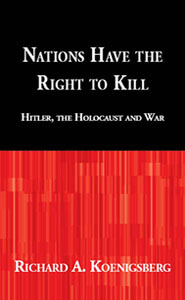
PRAISE FOR NATIONS HAVE THE RIGHT TO KILL —Ruth Stein, New York University, author of For Love of the Father __________________________________________________________________________ “Two terrors from long ago haunt. First, the Holocaust: that cold-blooded massacre of millions. Second, the ability of political leaders during two World Wars to convince ordinary people that slaughtering their neighbors was patriotic. A half-century later, we continue to ask: how was this possible? Richard A. Koenigsberg offers provocative answers. Koenigsberg’s analysis ranges from gender identity, to the First World War, to Aztec warfare. No single answer will exorcize our terrors. But Koenigsberg’s bold and original approach, clearly and precisely presented, will help us, if not to expel them, at least, finally, to comprehend them.” —Robert Whalen, Queens University of Charlotte, author of Bitter Wounds: German Victims of the Great War, 1914-1939 _____________________________________________________________________________| —Brian A. Victoria, Antioch University, author of Zen at War “In Nations Have the Right to Kill, Richard Koenigsberg poses disturbing and often ignored questions: ‘How can humans sacrifice millions for an abstract concept of “nation?” Is destruction and self-destruction the actual purpose of war?’ The answers are both insightful and unsettling. The strength of Nations is the use of original artifacts to support claims. Koenigsberg always begins with data. He takes a rhetorical approach by grounding his arguments in a careful analysis of Nazi writings, speeches and recorded correspondence and conversations. The point that nations grant their leaders the right to kill is powerfully documented.” —E. Sam Cox, University of Central Missouri “Richard Koenigsberg’s Nations Have the Right to Kill reminds us in clear and incisive prose that sacrifice and total war are inextricably linked. Drawing on a broad range of knowledge spanning the social sciences, Koenigsberg asks us to conceive of the Holocaust as the product of an ideology that demanded the sacrifice of both Germany’s male population and European Jewry.” —Brian E. Crim, Lynchburg College “Koenigsberg’s thesis is that there is a ‘fundamental dynamic that leads nations to go to war,’ independent of political circumstances. This purpose or driving force is destruction and self-destruction: a mass human sacrifice that elevates the nation to a sacred place at the expense of its people. In war, Koenigsberg says, ‘human bodies sacrificed in the name of perpetuating a magical entity, the body politic.’ This is a thoughtful, sometimes startling, well-written book: important and challenging.” “This is psychological inquiry of great depth and tragic urgency. A deep humanity and ethical urgency informs this book which is full of original and provocative insights.” —Walter A. Davis, Professor Emeritus, Ohio State Universityz __________________________________________________________________________ “Richard Koenigsberg represents an entirely orthogonal and de novo vantage on war. His academic lens is Psychology, and he has penetrated to a still-obscured truth of war in Modernity: That it is in essence the sacrificial—and thus transcendental—celebratory vessel of all human sacred identity. His essay is in its way a call-to-arms: To see at last our own buy-in culturally to a boundlessly destructive essence within our own humanity.” —Michael Vlahos, United States Naval War College, author of *Fighting Identity: Sacred War and World Change “Filling a gap in the scholarly narrative, Nations Have the Right to Kill uses a comparative framework to offer an intriguing exploration of the philosophical connections between war and genocide. Focusing on the Nazi case, Koenigsberg concludes that both the sacrifice of German soldiers in glory on the battlefield, and the sacrifice of victims in the gas chambers, served essentially the same purpose: to feed the sacrificial bloodlust of the national deity.” —Journal of Genocide Research. Review by Megan D. Lee, University of South Carolina. ____________________________________________________________________ “Nations Have the Right to Kill offers a riveting examination of the ideology of political violence. Dr. Koenigsberg observes that the slaughter of hundreds of thousands in the 20th-century has been so continuous that it is taken as an immutable characteristic of history. To interrupt our historical attachment to war, we might begin by examining the mentality and ideology of those who perpetrate political violence. Through careful analysis of Hitler’s writings and speeches, Koenigsberg makes us aware of the ideology that was the source of both warfare and genocide. Dr. Koenigsberg’s is a message that anyone with an interest in changing the course of human history should internalize and reflect upon. Can human beings transcend war? If so, Nations Have the Right to Kill will be one of our most important guides. Its striking lucidity will be a catalyst for our collective evolution.” —Lee Hall, JD |