|
Dear Colleague,
My colleague, Andrew Hammer, hipped me to the movie, The Fight Club (1999). The premise of this film, as far as I can tell, is that men can liberate themselves from oppression and the illusions of society by beating each other up (yes, that seems to be what the movie is about), And the men in this movie REALLY beat each other up. Blood and Gore. It's one of the most brutal movies I've ever seen.
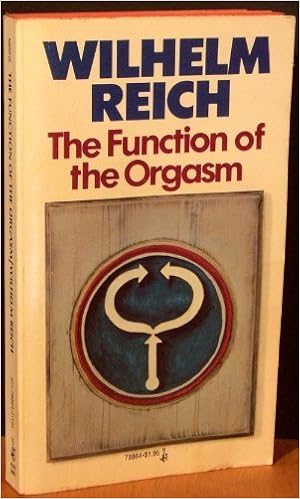
After some reflection, I recalled another approach to the idea of liberation from society-- that stemming from the writings and work of Wilhelm Reich, his most illustrious book being The Function of the Orgasm. Intense sexual experience leading to orgasm was conceived by Reich as the means to returning to the body, becoming conscious of one's sexual organ, experiencing the pleasure of sexuality, and leaving the world behind. In the throes of sexual experience, sexual pleasure and the intensity of orgasm, one leaves the entire "spear chuckin' scene" (Spike D'Arthenay) behind.
I hadn't thought of Wilhelm Reich and his theories in quite a while. Perhaps this is because I--and the entire world--have been enacting this theory. According to a recent (2023) study, 2.5 million people visit the world most popular pornographic websites every 60 seconds.
We're talking about people WATCHING people having orgasms and about people having orgasms while watching people having orgasms.
(See my short essay below:
WILHELM REICH: ORGASM AS THERAPY).
I think it would not be unreasonable to suggestg that Wilhelm Reich's ideas about sexuality, the importance of sexual pleasure and the significance of sexual orgasm are among the most influential of the past one-hundred years.
Freud discovered the significance of sexual desire as the source of human behavior but is associated with the idea of "sublimation."
Reich suggested that we ACT UPON our sexual desires. We now live in a world created by Wilhelm Reich.
Best regards,
Richard Koenigsberg
| Wilhelm Reich: Orgasm as Therapy |
| Richard A. Koenigsberg |
|
“Psychic health depends upon orgastic potency, i. e., upon the degree to which one can surrender to and experience the climax of excitation in the natural sexual act. Neurosis is nothing other than dammed-up sexual energy.”
“The entire politics of culture (film, novels, poetry, etc.) revolve around the sexual element, thrive on its renunciation in reality and its affirmation in the ideal. If all humanity dreams and poeticizes about sexual happiness, should it not also be possible to translate the dream into reality?”
—Wilhelm Reich
Wilhelm Reich took Freud’s theory of the sexual origins of neurosis seriously and sought to do something about it. Freud saw therapy as “making conscious the unconscious”—liberating sexuality from repression, but then helping the patient to control or sublimate his or her sexual impulses. Reich posed the question of whether it might not be possible for persons to “live out” their desires.
Wilhelm Reich's theory had a profound impact upon the American sexual revolution. In the Sixties, intellectuals and many others sought the “good orgasm” as a means toward achieving liberation, and happiness. Further, Reich’s idea—that blockages within the body suppressed energy and distorted character—became extremely influential.
An article in Harper’s Magazine in 1947 depicted the “builders of the new Paris”—a bohemian community of artists and writers that arose in Northern California, and evolved into the “beat” movement. According to Mildred Edie Brady:
The core of the philosophy of this new bohemia rests on the sexual thesis. If by strange and splendid chance you happen to be one of the few orgastic potent, you are one of the few “normal, natural, healthy human beings” left in a world peopled by terrified and frustrated neurotics.
Brady found that what differentiated this bohemia from its predecessor was that it was “profoundly religious,” but not in a conventional way. This bohemian community saw the “sexual sacrament” as the acme of worship, believing that God “revealed himself fully only in the self-effacing ecstasy of the sexual climax.”
Religious faith was supported by psychoanalytic argument: “The ultimate authority is no longer Freud, but one who now wears the mantle of Freud: Wilhelm Reich, whose The Function of the Orgasm is probably one of the most widely read and frequently quoted contemporary readings in this group.”
Reich’s ideas influenced both the “beat” movement of the Fifties and the hippie revolution of the Sixties. The “religion of the orgasm”—of sexual gratification—became central in American society. The sexual act, according to Norman Mailer and others, was one place where society could not enter or interfere.
The idea of sexual liberation became bound to rebellion against society. In the Sixties, the antimonies set up by Freud and Reich—between pleasure and civilization, health and society, the body and the intellect, liberation and oppression—became themes of the counterculture. The revolution of the Sixties— as well as subsequent liberation movements—took the side of the body and pleasure in the struggle against civilization. |
|
|