|
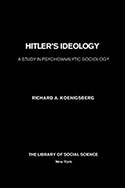
KOENIGSBERG'S RESEARCH AND WRITING--THE NEWSLETTERS YOU HAVE BEEN RECEIVING--BUILDS ON THE FOUNDATION OF THE FOUR BOOKS BELOW. TO ENCOURAGE YOU TO READ THESE BOOKS, WE ARE MAKING THIS SPECIAL OFFER:
PURCHASE ANY ONE BOOK AND RECEIVE A SECOND TITLE AT NO CHARGE. PURCHASE TWO BOOKS, AND RECEIVE TWO ADDITIONAL TITLES AT NO CHARGE.
FOR INFORMATION ON HOW TO ORDER, PLEASE CLICK THROUGH TO THE LINKS BELOW.
AS SOON AS WE RECEIVE YOUR ORDER, WE WILL SHIP THE ADDITIONAL TITLE OR TITLES AT NO CHARGE
PS: THE TITLES ARE IN AN EBOOK FORMAT: IDENTICAL TO THE ACCLAIMED HARDBOUND AND PAPERBACK EDITIONS
|
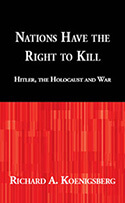
Praise for Nations Have the Right to Kill
“Richard Koenigsberg is an intrepid generator and disseminator of novel ideas regarding the psychodynamics of human violence and destructiveness, ideas that are startling all the more for being self-evident once they have been absorbed. Koenigsberg’s ideas cut trenchantly through conventionalnotions about culture, the nation, and war.”—Ruth Stein, Author, For Love of the Father: A Psychoanalytic Study of Religious Terrorism
___________________________________
“It is disturbing to consider how the minds of young men are manipulated to get them to kill. But there is an even more disturbing hypothesis. Scholar Richard Koenigsberg argues that war is the result of a desire on the part of a society to sacrifice its own young men.—Kent D. Shifferd, University of Wisconsin, in From War to Peace: A Guide to the Next Hundred Years
__________________________________
“Using Hitler as a focal point, Nations Have the Right to Kill offers a riveting examination of the ideology of political violence. Dr. Koenigsberg observes that the slaughter of hundreds of thousands in the 20th-century has been so continuous that it is taken as an immutable characteristic of history.
To interrupt our historical attachment to war, we might begin by examining the mentality and ideology of those who perpetrate political violence. No example looms larger than Hitler. What did Hitler’s cognitive map look like? Through careful analysis of Hitler’s writings and speeches, Koenigsberg makes us aware of the ideology that was the source of both warfare and genocide.
Dr. Koenigsberg’s is a message that anyone with an interest in changing the course of human history should internalize and reflect upon. Can human beings transcend war? If so, Nations Have the Right to Kill will be one of our most important guides. Its striking lucidity will be a catalyst for our collective evolution.”—Lee Hall, JD, Author, On Their Own Terms: Animal Liberation for the 21st Century
________________________________________________________________________
“If a case can be made that nationalism is a religion, few books rival Koenigsberg’s Nations Have the Right to Kill. The author confronts the taken-for-granted world of nationalism and political realism, and makes them suddenly seem utterly peculiar and bizarre. The strength of this book rests in fleshing out original lines of argument and grounding them in historical evidence. The force of Koenigsberg’s contention leaves little doubt that in analyzing nationalism and warfare, we are treading on a sacred ground in which ultimate and redemptive meanings are promised.”—Professor Matthew Eddy, Minot State University, reviewed in Journal for the Scientific Study of Religion
________________________________________________________________________
“Despite the vast body of research devoted to the Holocaust, Nations Have the Right to Kill marks a seminal contribution to our understanding. Koenigsberg challenges the belief that Hitler was a uniquely inhuman monster, placing him squarely within the narrative of the nationalist ideology that claims dying for one’s country represents the apogee of love and devotion. The Holocaust thus became ‘a perverted, degraded version of dying for the country—sacrificial death at the hands of the nation-state stripped of words like honor, heroism and glory.’ Given that both war and genocide remain pervasive in today’s world, Nations Have the Right to Kill forces us to reexamine, and reflect, on the true causes of these phenomena.”—Brian A. Victoria, Antioch University, author of Zen at War
______________________________________________________________________
“In this illuminating study, Dr. Richard A. Koenigsberg argues that war is a ritual process through which a nation becomes alive. Koenigsberg’s persuasive argument is based upon a dazzling array of historical examples across centuries, with special focus on Nazi Germany. With great precision, he shows how in the Second World War Hitler encouraged the death (murder) of thousands of his obedient soldiers. Nations Have the Right to Kill provides a fresh and passionate mode of theorizing war, showing how nations are constructed through sacrifice of self and other.”—Babak Rahimi, University of California, San Diego, author, Theater State and the Formation of Early Modern Public Sphere in Iran
______________________________________________________________________
“By questioning the taken-for-granted idea that wars are waged for specific and ‘real’ reasons, Dr. Richard A. Koenigsberg challenges the ‘rational choice’ theory and advances an alternative rationale for nations' proclivity to wage wars. His central thesis is that nation-states decide to go to war—not in order to control vast new territories and gain larger shares of natural resources and wealth—but rather in order to create opportunities for killing and dying. In other words, war is not a means to and end but rather an end in itself. This book challenges us to rethink our taken-for-granted ideas about nations and the justifications advanced by our leaders to wage wars.”—Younes Abouyoub, Columbia University
______________________________________________________________________
“In Nations Have the Right to Kill, Richard Koenigsberg poses disturbing and often ignored questions: ‘How can humans sacrifice millions for an abstract concept of “nation?” Is destruction and self-destruction the actual purpose of war?’ The answers are both insightful and unsettling. The strength of Nations is the use of original artifacts to support claims. Koenigsberg always begins with data. He takes a rhetorical approach by grounding his arguments in a careful analysis of Nazi writings, speeches and recorded correspondence and conversations. The point that nations grant their leaders the right to kill is powerfully documented.”—E. Sam Cox, University of Central Missouri
_______________________________________________________________________
“Richard Koenigsberg’s Nations Have the Right to Kill reminds us in clear and incisive prose that sacrifice and total war are inextricably linked. Drawing on a broad range of knowledge spanning the social sciences, Koenigsberg asks us to conceive of the Holocaust as the product of an ideology that demanded the sacrifice of both Germany’s male population and European Jewry. Nations Have the Right to Kill contains thought provoking conclusions about war and genocide in the twentieth century. The Third Reich is a unique case, but the notion that nations demand and expect a blood sacrifice is one of the hallmarks of the modern age.”—Brian E. Crim, Lynchburg College, author, The German Right in the Weimar Republic: Studies in the History of German Conservatism, Nationalism, and Antisemitism
_______________________________________________________________________
“Koenigsberg’s thesis is that there is a ‘fundamental dynamic that leads nations to go to war,’ independent of political circumstances. This purpose or driving force is destruction and self-destruction: a mass human sacrifice that elevates the nation to a sacred place at the expense of its people. In war, Koenigsberg says, ‘human bodies sacrificed in the name of perpetuating a magical entity, the body politic.’ This is a thoughtful, startling, well-written book: important and challenging.”—E. James Lieberman, M.D., Metapsychology Online Reviews
_____________________________________________________________________
““This is psychological inquiry of great depth and tragic urgency. A deep humanity and ethical urgency informs this book which is full of original and provocative insights.”—Walter A. Davis, Professor Emeritus, Ohio State University
_______________________________________________________________________
“Richard Koenigsberg represents an entirely orthogonal and de novo vantage on war. His academic lens is Psychology, and he has penetrated to a still-obscured truth of war in Modernity: That it is in essence the sacrificial—and thus transcendental—celebratory vessel of all human sacred identity. His book is in its way a call-to-arms: To see at last our own buy-in culturally to a boundlessly destructive essence within our own humanity.”—Michael Vlahos, Global Security Studies Program, Johns Hopkins University, author, Fighting Identity: Sacred War and World Change
_______________________________________________________________________
“Filling a gap in the scholarly narrative, Nations Have the Right to Kill uses a comparative framework to offer an intriguing exploration of the philosophical connections between war and genocide. Focusing on the Nazi case, Koenigsberg concludes that both the sacrifice of German soldiers in glory on the battlefield, and the sacrifice of victims in the gas chambers, served essentially the same purpose: to feed the sacrificial bloodlust of the national deity.”—Megan D. Lee, Journal of Genocide Research
_______________________________________________________________________
“Scholars in Holocaust and Genocide studies will welcome Nations Have the Right to Kill: Hitler, the Holocaust and War. Richard Koenigsberg shows how Hitler’s obsession with the death of millions of German youth during the First World War—combined with his belief that Jews had shirked their military responsibilities—led to the Holocaust. Combining solid historical scholarship and profound psychological insight, he opens the door to a host of further explorations. This book is recommended for courses that address the whys of the Holocaust, as well as historical and contemporary genocides.”—Dr. Steven Leonard Jacobs, Department of Religious Studies and Chair of Judaic Studies, University of Alabama, author, Modern Genocide: The Definitive Resource and Document Collection
|