|
I. The Power of the Pharaoh
Louis Mumford examines the meaning of Kingship in ancient societies such as Egypt in his The Myth of the Machine: Technics and Human Development (1967). He writes about the absolute power associated with Pharaohs and other kings in early Near Eastern civilizations. The king, Mumford says, was conceived as a “god in his own right.” When he uttered a command, it had to be obeyed.
Because everyone had to obey the commands of the king, therefore words coming from his mouth could “bring a world into existence.” Mumford articulates a relationship between the obligation of Egyptian subjects to obey--and the king’s capacity to create a “colossal labor machine.” The special powers that the King commanded enabled him to bring together human beings to work on gigantic projects.
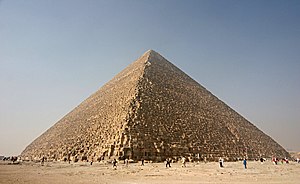
| The Great Pyramid of Giza |
 |
| Khufu |
The Pharaoh was conceived by the Egyptians as the living incarnation of society. The community lived and flourished vicariously through the king. By virtue of the king’s centrality, the community attained a sense of coherence or unity. Mumford states that the king alone had the power to create a “colossal labor machine:’ the godlike power of “turning men into mechanical objects and assembling these objects into a machine.” Mumford uses the term “megamachine” to describe the gigantic labor force that the king—by virtue of his godlike status—could command and direct.
Because of the Pharaoh, Egyptian society had the capacity to engage in building giant, collective works such as pyramids. The king gave forth commands, demanded absolute conformity, and punished even trivial disobedience. Kings demonstrated how much popular communities—once collectively organized in great mechanical units—could accomplish. By virtue of their capacity to mobilize tens-of-thousands of human beings into a great labor force, kings accomplished big things.
There was, however, a human price to be paid: absolute subjection to the king. Metaphors appearing in ancient Pyramid texts convey a kind of “unrestrained cannibal lust” dwelling on the scope and power of the divine king. The most horrendous crimes punished by civilized authority stemmed back to the “unpardonable sin” of disobedience to the sovereign.
“Murderous coercion,” Mumford says, was the royal formula for establishing authority, securing obedience, and collecting booty, tribute, and taxes. The other side of the coin of the creation of a colossal labor machine, in short, was the requirement that subjects be absolutely obedient. Mumford claims that, at bottom, every royal reign was a “reign of terror.”
The great projects brought forth by the Ancient Egyptians, then, grew out of the following dynamic: First, the belief that the king was the embodiment of a god. And secondly that—because of the king’s divine status—absolute obedience was required. The capacity of the Pharaoh to command obedience allowed him to produce a colossal labor force capable of undertaking gigantic building projects.
Building monumental structures such as a pyramid required enormous sacrifices by the populace. Soldiers, similarly, were required to be obedient to the sovereign and to perform acts of sacrifice. The capacity to generate collective sacrifice, Mumford believes, remained the identifying mark of sovereign power throughout history.
Mumford concludes that the two poles of civilization are mechanically organized work and mechanically organized destruction (or extermination). The king’s extraordinary power derived from his capacity to bring many people together into a single unit, and to command their absolute allegiance.
|
