|
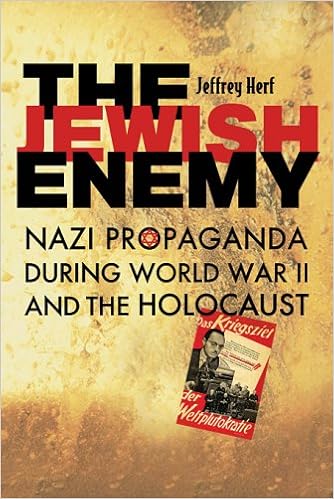
Understanding Nazi anti-Semitism, the Holocaust and the German war against the Soviet Union begins with the ideas and conclusions presented in Jeffrey Herf's The Jewish Enemy. Please scroll down to read Herf's conclusions--and more. The proper study of Nazism and the Holocaust begins with the proposition that the Jews, hatred toward Jews, and the wish to exterminate the Jews--lay at the heart of Hitler's world view, that is, at the heart of Nazi ideology. It has been thoroughly documented that there was no foundation in reality for Hitler's views about the Jews. The statistics supporting this view are everywhere in the literature--and presented in many of my Newsletters. The evidence leads to the conclusion that Nazi anti-Semitism was based on a fantasy, more accurately, a shared fantasy. Herf notes that the Nazi leadership pushed to the extreme the "widespread capacity for delusion." The assumption that these men did not believe their fantasies relies on an "optimistic view of the power of human rationality." The balance of Herf's conclusions appear below. Hitler put forth certain fantasies about the nature of the Jew, which transformed into and came to constitute Nazi ideology. The Final Solution enacted Nazi fantasies about the Jew, that is, enacted the fantasies embodied in their ideology. I would go a step further and say that Nazism and the Holocaust constituted a shared psychosis, a psychosis that came to define reality for the German people. Conclusion of Jeffrey Herf's The Jewish Enemy: The Nazis leadership pushed to the extreme the widespread human capacity for delusion. The assumption that these men did not believe these fantasies relies on an optimistic view of the power of human rationality. The weight of evidence leads to the conclusion that members of the Nazis leadership viewed the world in the way that they said they did, and supplied a narrative of events that offered an iron-clad explanation as well as justification for uniting ideology and practice in war and mass murder. If sheer repetition, in public and private contexts, can be taken as proof of belief, then it appears that Hitler, Goebbels, Dietrich, their staffs, and an undetermined percentage of German listeners and readers believed that an international Jewish conspiracy was the driving force behind the anti-Hitler coalition in World War II. If they regarded their own propaganda with cynicism, they did not leave much trace of that skepticism behind. The sources point to the presence of true believers. who acted as if the Final Solution was Nazi Germany's punishment of the Jews, whom the Nazis found guilty of starting and prolonging World War II. |
||||
Since the formulation of the concept of ideology during the French Revolution, political sophistication in modern politics has meant looking beyond manifest statements for their latent or real meaning and viewing ideas as instruments used for other purposes. This rationalist bias prevented observers across the political spectrum from seeing Nazi anti-Semitic propaganda as anything more than a revolting bundle of rationalizations opportunistically seized upon by base and evil men. Despite the vast literature on Nazis Germany, World War II, and the Holocaust, the rationalist bias about human motivation has persisted, reinforced by the positivism of the social sciences and challenges to intellectual and cultural history within the discipline of history. Resistance to grasping the power and impact of nonrational and irrational currents in Nazis Germany has been considerable. The Nazis leadership pushed to the extreme the widespread human capacity for delusion and belief in illusions. The assumption that these men did not believe these fantasies relies on an optimistic view of the power of human rationality, justified neither by the events of modern history nor by our now widespread awareness of the role of nonrational forces in human experience. The weight of evidence leads to the conclusion that members of the Nazis leadership viewed the world in the way that they said they did, and supplied a narrative of events that seemed to offer an iron-clad explanation of them as well as justification for uniting ideology and practice in war and mass murder. If sheer repetition, in public and private contexts, can be taken as proof of belief, then it appears that Hitler, Goebbels, Dietrich, their staffs, and an undetermined percentage of German listeners and readers believed that an international Jewish conspiracy was the driving force behind the anti-Hitler coalition in World War II. If they regarded this aspect of their own propaganda with cynicism, they did not leave much trace of that skepticism behind. Yet the sources point to the presence of true believers. They certainly acted as if the Final Solution was Nazi Germany's punishment of the Jews, whom the Nazis found guilty of starting and prolonging World War II. Hitler and Goebbels called their own institution the Ministry of Public Enlightenment and propaganda. Heirs to an age of suspicion of all ideologies, they were modernists of a crackpot sort who believed they had discovered the real truth lurking hidden behind the scenes. They believed that they understood the way the world really worked better than did the masses mired in contingency and trapped by common sense. |