|
The phrase "like sheep to the slaughter" is often used to describe the fate of Jewish Holocaust victims. However, the same phrase may be applied to German soldiers on the way to the Western Front at the start of the First World War: cheerful young men having not the slightest clue as to what their fate will be. Please scroll down to see photos of cheerful German soldiers below: in cattle-cars heading for France.
Hitler was among the men that travelled to to the Western Front, excited and exhilarated. What a shock the reality he encountered must have been!
The final solution: 2,037,000 dead; 4,300,000 wounded; 974,977 missing or prisoner; total casualties 7,311,977 (Whalen, 1984). Hitler wasn't killed (although he was wounded), but millions of his comrades were:
And by the way: The cattle cars that sent German soldiers to their deaths in the First World War were the same cattle cars that sent Jews to their deaths in the Holocaust. Perhaps not by chance. Hitler was making a point: "Do unto others as has been done unto you." The repetition compulsion: as your young men were slaughtered, so Jews shall be slaughtered: symbolic substitution.
| LIKE SHEEP TO THE SLAUGHTER |
| German Soldiers in cattle-cars on the Way to the Western Front |
|
|
|
|
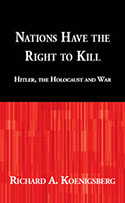
ABOUT NATIONS HAVE THE RIGHT TO KILL:
Hitler, the Holocaust and War
(scroll down or click here for information on purchasing)
Why did Hitler believe that it was necessary to destroy the Jewish race? What was the purpose and meaning of this extraordinary project the Nazis called "The Final Solution?" Richard Koenigsberg shows how genocide grew out of the logic of warfare. Hitler reasoned that if he had the right to sacrifice his soldiers, he also had the right to send Jews to their deaths.
Hitler embraced his role as military leader, stating in the mid-thirties that if millions of Germans had to die in the next war, he would not shrink from this sacrifice. Based on a meticulous reading of Hitler's speeches and Mein Kampf, Koenigsberg shows how Hitler's thinking about warfare led to his decision to exterminate the Jews. Hitler reflected that if he had no compunctions about sending the "best" people to die in battle--German soldiers--why would he not also have the right to send the "worst" people--mortal enemies of Germany--to their deaths?
A work of stunning originality, Nations Have the Right to Kill changes forever our understanding of the motives that drive nation-states toward destruction and self-destruction. Focusing on the two World Wars and the Holocaust, this book provides insights into the “hidden narratives” operating under the radar of history.
PRAISE FOR NATIONS HAVE THE RIGHT TO KILL
“Two terrors from long ago haunt us still. First, the Holocaust: that cold-blooded massacre of millions. Second, the ability of political leaders during two World Wars to convince ordinary people that slaughtering their neighbors was patriotic. A half-century later, we continue to ask: how was this possible? Richard A. Koenigsberg offers provocative answers. Koenigsberg’s analysis ranges from gender identity, to the First World War, to Aztec warfare. No single answer will exorcize our terrors. But Koenigsberg’s bold and original approach, clearly and precisely presented, will help us, if not to expel them, at least, finally, to comprehend them.” —Robert Whalen, History Department Chairman, Queens University of Charlotte, author of Bitter Wounds: German Victims of the Great War, 1914-1939
“Richard Koenigsberg skillfully confronts the taken-for-granted worlds of nationalism and political realism. The strength of this book rests in fleshing out original arguments and grounding them in historical evidence. Throwing back the curtains on the nation-state, Koenigsberg interrogates motivations behind the human tragedies of the two World Wars.” —Matthew Eddy, Journal for the Scientific Study of Religion
“Combining solid historical scholarship and profound psychological insight, this book is recommended for courses that address the whys of the Holocaust, as well as historical and contemporary genocides. Koenigsberg opens the door to a host of further explorations.”
—Dr. Steven Leonard Jacobs, Department of Religious Studies and Chair of Judaic Studies, University of Alabama
“Nations Have the Right to Kill is a fresh and passionate mode of theorizing war.”
—Professor Babak Rahimi, Program for the Study of Religion, University of California, San Diego
“Nations have the Right to Kill is a passionate monograph that presents a searing criticism of the sacrificial ideology that mobilizes people for war.”
—Michael Roberts, Professor of Anthropology, University of Adelaide
|