 |
 |
The Holocaust repeated the mass-slaughter of the First World War
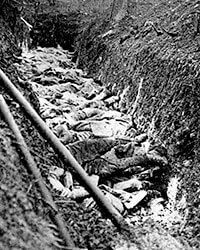
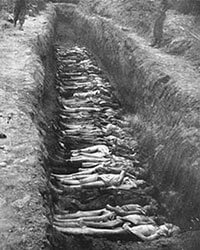
Mass-graves: World War I & the Holocaust |
| World War I (left) & the Holocaust (right) |
|
|
Omer Bartov had an inkling of the relationship between the First World War and the Holocaust-- which he discussed (1996) in Murder in Our Midst: The Holocaust, Industrial Killing and Representation.
Bartov suggested that the “very concept of mass-killing of human beings by states”—the genocide of the Jews—was “lifted directly from the Great war”—the realities of 1914-1918.
The death camps, Bartov said, were architecturally and organizationally modeled on the experience of the Great War, “incorporating all the attributes of a military environment,” such as uniforms and barbed wire, watch towers and roll calls, hierarchy and order, drill and commands. The Holocaust was therefore a “militarized genocide.”
What was present during the First World War, Bartov stated, was also present at the death camps: the barbed wire, machine guns, charred bodies, the gas, the uniforms, and the military discipline.
The Holocaust was “almost the perfect reenactment of the Great War,” with the important correction that “all the perpetrators were on one side and all the victims on the other.” This reenactment was “totally lethal for the inmates and totally safe for the guards."
|