Thank you very much for Professor Robert Griffin's responses to my inquiry about the First World War (see directly below).
Yes, there were multiple causes. Perhaps the most parsimonious explanation is the one often provided by historians: "One thing led to another."
However, a deeper understanding is contained within the term teleology: "A philosophy of teleology sees purpose in ends rather than stated causes, making the outcome the actual, or "final" cause. When you see things in terms of teleology, you explain actions by their results." The Greek term teleos means "complete," and its root telos means "result."
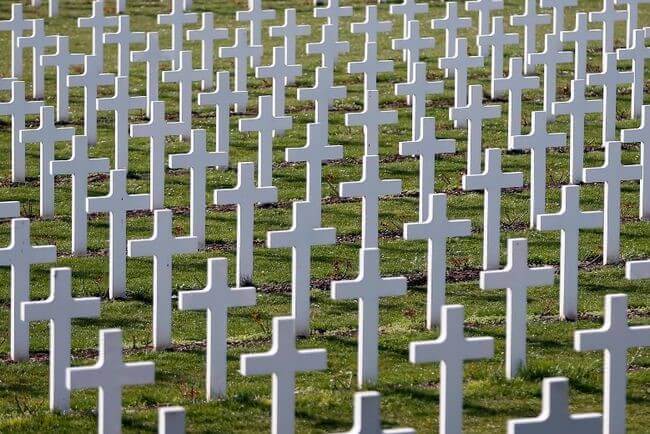
The telos of the first world war is revealed in the image below. The cause of the First World War was the result that was brought into being.
After all is said and done, the political machinations, the campaigns, the killing and dying--the telos was simple: to produce dead soldiers and memorials to the dead.
Simple and and perhaps obvious, but very disturbing: that the war was fought to produce dead bodies and memorials to the dead. A truth perhaps more disturbing than Darwin's idea that we are descended from lower forms of life.
If we embrace this truth, it is possible to understand the rest of the first half of the Twentieth Century, and perhaps the nature of warfare itself.
As Timothy K. Barlett might put it, "Fear and trembling, sickness unto death."
Sorry,
Richard Koenigsberg
|
_________________________________________________________________________________________________________ROGER GRIFFIN ON THE FIRST WORLD WAR:
1. I am not a world authority on the dynamics of fascism, but just one of the more influential theories in the field of comparative fascist studies.
2. I am certainly no expert on the First World War or its causation.
3. The causality of the First World War is extremely complex, multifactorial and involves a different complex or cluster of factors and drivers in every state, empire, or ethnicity involved.
4. There is a profound gap between the conscious reasons which led politicians, ruling elites, and military leaders in each country to declare war, join alliances, mobilize the population and send many hundreds of thousands of young men to experience horrendous and futile suffering, many of them meeting a horrendous fate.
5. The psycho-cultural dynamics of the sustained belief among large sections of the ruling elites, within the population at large, and among some soldiers in many but not all countries (e.g. Italy) that the war was necessary, meaningful, and in some sense heroic and glorious does seem to me to be incomprehensible at a rational or humanist level (or for that matter a socialist, Christian, Muslim, Buddhist etc level). In fact it seems grotesque, horrifying 'mad.’
6. Certainly the idea that at a deep anthropological, mythopoeic level the war was a sacred duty and conferred on those who died the honour of a sacrificial death performed not for a divine entity but for a sacralized nation makes a lot of sense to me.
7. However i) we have to be careful about generalizing because not all countries experienced the phenomenon of the sacralization of war and death to the same degree; ii) there were many dissenting voices; iii) many caught up in the fighting experienced the war as grotesque, terrifying, absurd and traumatic.
8) There are many partial explanations of the mass phenomenon of sacralization: I am particularly drawn to the work of Ernest Becker concerning the human need for immortality projects and theories of secularization that posit that the lost sacred is projected/transferred to new entities such as the nation, but the Muslim Ottoman empire also officially sacralized the death of its soldiers.
9) I see your work as an illuminating part of the causal jigsaw alongside my own work on 'modernity'/desacralization and modernism/resacralization.
10) But ultimately we have to be satisfied with half truths and fragments of insight. The dynamics of the human mind and the social organism is ultimately a mystery of a complexity beyond the comprehension of any one researcher.
Does that make sense?
Best wishes
Roger