|
||
|
Waging the First World War, human beings declared their devotion to a sacred object, the nation-state. World War I was a monumental, grotesque sacrificial competition—as each nation demonstrated its willingness to “gift” the lives of young men. The principle psychic determinism applies to the cultural domain just as it applies to the life of individual human beings. Cultural creations convey the desires of human beings. Warfare is a human creation expressing the desires of human beings. What are the nature of those desires that generates warfare? Following wars, human beings create memorials testifying to the existence of this transcendent realm. People believe that the prodigious killing and dying must have occurred for the sake of some thing. We refuse to imagine that the sound and fury occurred in the name of no-thing. |
||
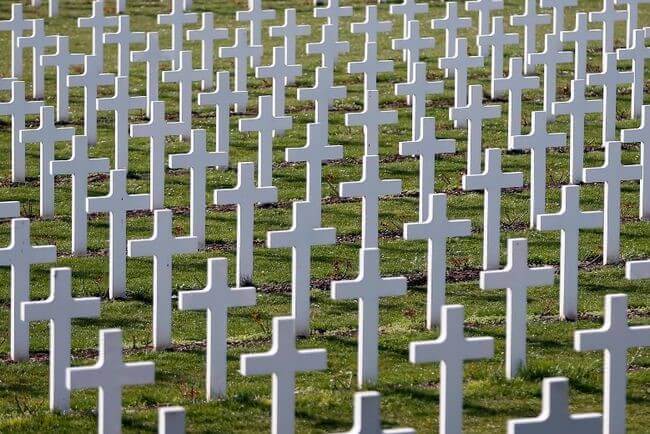
The First World War reached its conclusion—not when the last machine guns had been fired nor when artillery guns rested. The conclusion of the war consisted of the memorials erected to prove that soldiers had died, and to honor these soldiers. The crosses to the right (a very small sample of memorials created during and after the First World War) constitute proof that young men had devoted themselves—given their lives—for their nations: proof of the reality of a transcendent domain of human experience separate from ordinary existence. The crosses point to a super-human realm of human existence. During the First World War, each nation asserted the reality of its own sacred object, asserted its superiority and demonstrated the depth of its devotion by virtue of its willingness to gift young men. The war ended—not because one side had “defeated” the other—but when one side ran out of sacrificial victims. |