|
|||
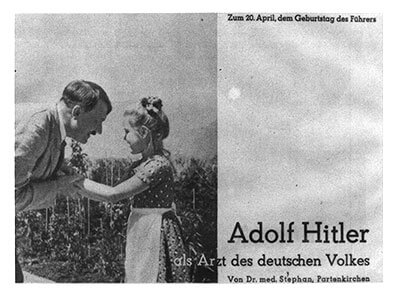
Saving the Life of the National Organism After the First World War, Hitler felt that the German people were suffering—and that Germany's suffering was the result of a disease they had acquired. The first task of a German politician, therefore, was to diagnosis the nation’s disease—disclose its cause. In Mein Kampf (1923), Hitler wrote that the efforts of ordinary German politicians, "tinkering around on the national body," were condemned to sterility because they saw at most the forms of the disease, but "blindly ignored the virus." Ordinary politicians were aware that Germany was ill, but unable or unwilling to comprehend the causes of Germany's disease. Hitler, by contrast, staked his claim to leadership based on his capacity to diagnosis and cure Germany's illness. He believed people would follow a political leader who "profoundly recognized the distress of his people," worked to attain the "ultimate clarity regarding the nature of the disease"--and then "seriously tried to cure it." Reflecting on Germany's disease in Mein Kampf, Hitler asserted that every distress has "some root or other." It was not enough for the Government to issue emergency regulations amounting to "doctoring around on the circumference of the distress” and trying “from time to time to lance the cancerous ulcer." Viewing them as pathogenic microorganisms, Hitler identified Jews as the source and cause of Germany's disease. He believed that the continuing presence of Jews within the nation would lead to its demise. It was necessary, therefore—to cure Germany's disease—to eliminate the Jew from within the body politic. The Nazi movement was conceived as a struggle of life against death between the healthy German organism and the viral Jewish element. In order to combat Germany's disease, Hitler believed it was necessary to mobilize the will of the German people—to fight the disease. Hitler challenged his people: Do you have the insight to perceive the cause of Germany’s disease? Do you have the courage to rise up and take action against it? Germans would enter a "fight against death”—rising up against the fate that had been planned for them. If they did not, the nation would sink, and the German people—through their "despicable cowardice”--would sink with it. Taking action meant doing whatever was necessary to save the life of the nation. A momentous struggle would ensue to determine "which is stronger: the spirit of international Jewry or the will of Germany." From the beginning of his career, Hitler framed his ideology as this "either-or" conception. "The future of Germany," he declared, means "the annihilation of Marxism." Either the "racial tuberculosis" would thrive and Germany would die out; or it would be "cut out of the Volk body," and Germany would thrive. The Final Solution involved cutting out the racial tuberculosis—in order to save the life of the German organism. |