|
||||||
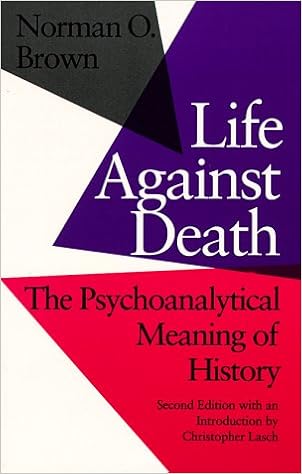
Freud suggests that the mythological conception of the universe is only psychology projected onto the outer world. Not just mythology, Norman O. Brown says, but the entirety of culture is a projection." The world we create--”the world of slums and telegrams and newspapers"--is a kind of "language of our inner wishes and thoughts." Once we recognize the limitations of talk from the couch, it becomes plain, Brown explains, that there is "nothing for psychoanalysis to psychoanalyze except these projections:" the world of slums and telegrams. Thus, psychoanalysis fulfills itself "only when it becomes historical and cultural analysis." Beginning with the proposition that the symbolic order is created or produced by human beings, significant questions follow: How may we account for the nature and shape of specific ideas and institutions? Why do some ideas and institutions become stable, persistent elements of culture (while others do not)? To understand the sources and meanings of institutions and ideologies, we enter the realm of psychology. As soon as we focus on human beings as creators and producers of society--not merely as "subjects of the symbolic order--an entire world of exploration opens up. Norman O. Brown's seminal Life against Death: The Psychoanalytic Meaning of History asks why the psychoanalytic ideas and theories should be confined to the clinical situation. What would it mean to bring psychoanalysis into the arena--to analyze the entire human race, not just individuals? At the core of psychoanalytic theory and therapy is the concept of transference, which refers to the process whereby a patient transfers his or her feelings and fantasies into (or onto) the analyst. A central methodology of psychoanalytic therapy is "analysis of the transference." The transformation of psychoanalysis into a project to change culture, Brown says, is a solution to the unsolved problem of the transference. The transference was necessary because the unconscious can become conscious only if "transformed into an external perception." The external perception has to be based on the "enactment of actual love (or hate)." Brown explains that the unconscious can become conscious only through "projection onto the external world." Human culture, therefore, is a set of "projections of the repressed unconscious." Like the transference, culture is created by the repetition compulsion and constantly produces "new editions of the infantile conflicts." Like the transference, human culture exists in order to "project the infantile complexes into concrete reality, where they can be seen and mastered." What a powerful phrase "in order to." With this phrase, we may overturn or overthrow repressive social theories that have dominated academia for so many years--theories that view the symbolic order as an objective reality independent of human agency. The phrase "is created in order to"--suggests that culture is created by human beings--and contains a human function or purpose. Culture is not separate from us. It belongs to us. We have created institutional forms, ideologies, etc. as the expression of who we are. Berger states that the social order is produced by human beings in the "course of our ongoing externalizations." Brown shows a way to illuminate the precise nature and meanings of these externalizations. Human culture, Browns says, is a "vast arena in which the logic of the transference works itself out." The infantile fantasies that create the human neurosis cannot be directly apprehended or mastered, but their derivatives in human culture can." Culture thus does for all mankind what the transference phenomena were supposed to do for individuals. The real nature of the primal fantasies is revealed by the fact that they "cannot be remembered, but only re-enacted." Fantasies do not exist in memory or in the past, but only as "hallucinations in the present." The repressed unconscious can become conscious only by being "transformed into an external perception;" by being projected. It follows that consciousness of the repressed unconscious is "itself a cultural and historical product"--”since the repressed unconscious can become conscious "only by being transformed into an external perception in the form of a cultural projection." |
||||||