Hitler's experience of the German nation as a body
Richard A. Koenigsberg
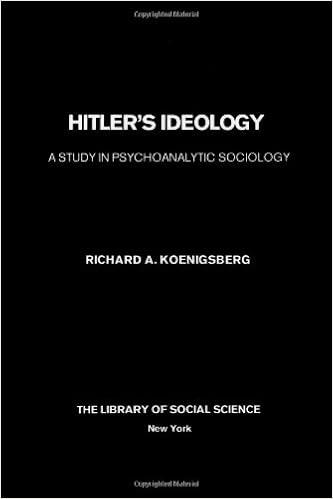
Hitler's Ideology: A Study in Psychoanalytic Sociology

For information on ordering the E-Book at the special rate of $2.98, please click here.
“The best critical analysis in English of Hitler’s thought.” --Colin Day

"Koenigsberg's genius has unlocked the  secrets of a timeless drama." --Howard F. Stein

My theory relating nationalism to the idea and experience of the human body began with my study of Hitler's rhetoric and subsequent book, Hitler's Ideology.

When I began reading Mein Kampf and Hitler's speeches, I didn't have anything specific in mind, other than the idea that it might be a good thing to solve the problem of "why the Nazis killed the Jews" (the causes of the Holocaust).

I began noticing the recurrence of bodily images pervading Hitler's writings and speeches. There was no theory of "embodied metaphor" at the time. I simply was astonished by the recurrence of certain bodily images and metaphors. 

I reconstructed Hitler's vision of the nation as a body and conveyed my findings through the vehicle of a series of Tables, the first of which is below, "The Country is a Living Organism."

I didn't know what I was getting into at the time. However, as in turns out, this idea or conception or experience of the German nation lay at the heart of Hitler's thought and of everything that occurred in Nazi Germany.

There was one mysterious sentence (from Mein Kampf, Statement #2 below) that particularly fascinated me: "Could anyone believe that Germany alone was not subject to exactly the same laws as all other human organisms?"

I eventually realized that Hitler was referring to the Law of the Immune System, that property of organisms that causes them to reject or eject or destroy foreign or alien cells. 

Table 1. of Hitler Ideology: "The Country is a Living Organism"

Statement Number Statement Source
Book Page
1 France was tearing piece after piece out of the flesh of our national body. MK 133
2 Could anyone believe that Germany alone was not subject to exactly the same laws as all other human organisms? MK 155
3 Our movement alone was capable of creating...a national organism. MK 329
4 From a dead mechanism (the state) there must be formed a living organism. MK 398
5 It will be the task of a folkish state to make certain...that...an influx of fresh blood...takes place. MK 432
6 An attempt to restore the border of 1914 would lead to a further bleeding of our national body...so that there would be no worthwhile blood left. MK 651
7 In case of a war...the German nation (would be) bled white. MK 659
8 The state...is a "volkic" organism. S-I 85
9 In place of...the State--must be set the living organism--the people. S-I

188

10 The towns would not exist...if the peasant did not fill them with his blood. S-I 242
11 What remains is the substance, a substance of flesh and blood, our nation. S-I 433
12 The "living substance," the German people, is a present reality. S-I 441
13 (The) task...was...to build up the entire administration (of the state)...until it became a close organic whole, pulsing with life. S-I 486
14 So much blood has been drawn off...into German economic life abroad...that the circulation has been stopped. S-I 829
15 Economics...is a living process, one of the functions of that body which is the people. S-I 851
16 The Polish Corridor...is like a strip of flesh cut from our body...a national wound that bleeds continuously, and will continue to bleed till the land is returned to us. S-I 995
17 The German people...had become a body corporate pulsing through and through with a vital inner life. S-I 1253
MK: Hitler, A. (1962). Mein Kampf (R. Mannheim trans.). Boston: Houghton Mifflin Company.
S-I: Baynes, N. H. (Ed.). (1942). The Speeches of Adolf Hitler, Vol. 1. New York: Oxford University Press.