|
Hitler proclaimed to his youth: “You are flesh of my flesh, blood of my blood. You are all one, belonging to me.” This was Hitler's deepest fantasy and most profound desire: that each and every German be united with him--bound to his body--to constitute a single, omnipotent body.
If you look at the photo on the lower right below you will see what this looked like in practice: tens-of-thousands of men crowded closely to one another: "bound inseparably together," as Hitler put it.
Margaret Mahler defined symbiosis (2000) as the state of "undifferentiation, of fusion" in which the 'I' is "not yet differentiated from the 'not I'." The essential feature of symbiosis, she said, is "hallucinatory or delusional, somatopsychic omnipotent fusion" and, in particular, the delusion of a "common boundary of physically separate individuals."
The Nazi movement represented the desire to create the fantasy of symbiosis in the form of the union of many individuals constituting the group. Hitler's dream was to fuse the German people one to another.
Hitler's idea was precisely the fantasy conveyed by the famous frontispiece of Hobbes' Leviathan (see on the left below), which depicts a gigantic man whose torso and arms are composed of tiny individual men crowded closely together. Each of these tiny men was bound to the body of the sovereign. In Leviathan (1651), Hobbes stated that the way to create a Commonwealth is to “unite the multitude in one and the same person.”
The political fantasy of "uniting the people" is fundamentally a psychosomatic one: the idea that each and every individual be bound to each and every other individual--united to constitute a single body.
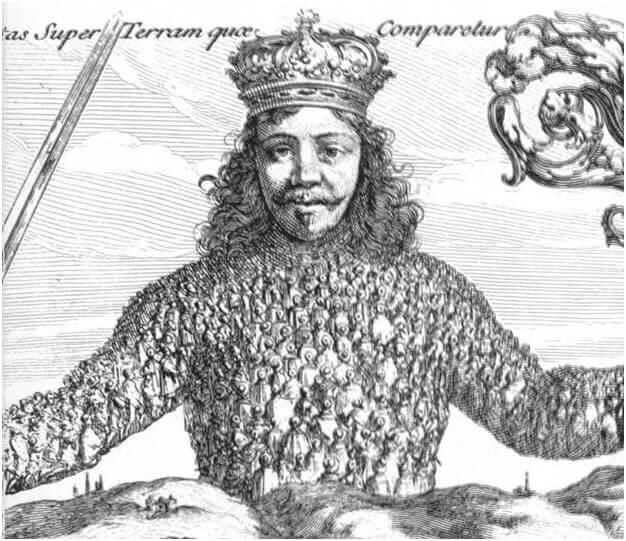
The frontispiece of Leviathan depicts a man whose torso and arms are composed of tiny individual persons crowded closely together. |
|
|
 A massive rally at Nuremberg (1937) composed of thousands of men crowded closely together. |
|
|
|