“You are Nothing, Your Nation is Everything.”
Richard A. Koenigsberg

The “Final Solution” grew out of the euthanasia movement (the killing of mental patients). Each was intended to exterminate human beings deemed to be "life unworthy life:" of no value to Germany.

Hitler declared to his people, "You are nothing, your nation is everything." Extermination of mental patients and Jews grew out of this phrase. If the nation is everything and the individual nothing, then if one cannot contribute to the nation, one might as well be dead.

The first mental patient was killed in August 1938. The Holocaust began (in the Soviet Union) in July 1941. Thus, it took three years for the euthanasia movement to evolve into the Final Solution. In short, the Holocaust did not come out of nowhere. It did not happen all at once. It was the result of a gradual psycho-social process.

I'm working now on a lecture in which I trace the evolution of mass-murder in Nazi Germany--how the killing of mental patients evolved into the killing of Jews.

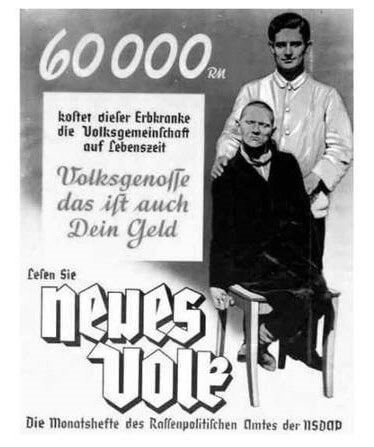
Nazi propaganda poster supporting the sterilisation or euthanasia of people with mental disabilities. The text reads: "60 000 Reichsmarks is what this person suffering from a hereditary defect costs the People's community during his lifetime. Fellow citizen, that is your money too.

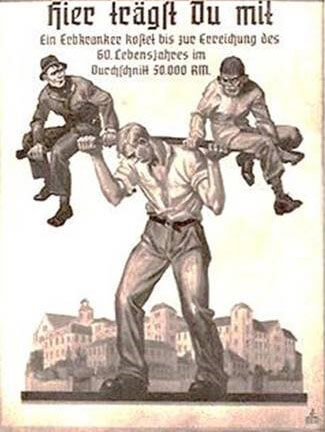
Nazi propaganda poster expressing the idea that those with physical and mental disabilities are a burden to the German nation.
The essence of Nazi ideology is contained within a phrase uttered by Hitler to his people: “You are nothing, your nation is everything.” The “euthanasia movement”—killing of those deemed “unworthy of life”—grew out of the logic contained within this phrase.

Human beings within the framework of the Nazi movement “counted” only insofar as they could contribute to the national project. Those unable (or unwilling) to contribute—were deemed useless.

A seminal book set the stage for Nazi mass-murder. Permitting the Destruction of Life Unworthy of Life (1920) was authored by two eminent German scholars—lawyer Karl Binding and psychiatrist Alfred Hoche. They argued that physicians may in some instances be compelled to destroy life in the “interests of the higher good.”

However, during the 1930s the Nazis promoted the idea that people with disabilities impacted negatively upon Germany. As posters to the right suggest, this issue was framed primarily in economic terms."

Mathematics texts included problems asking students to compute the amount of money lost to the state in a lifetime of providing care for "worthless ballast."

The idea of destroying “life unworthy life” was not acted upon until Hitler initiated the “T-4 Euthanasia Program” in 1939—that involved killing people who were incurable ill, physically or mentally disabled, or emotionally distraught. This program was conducted secretly.

"Mercy death" and "euthanasia" were the most common terms employed for the mass-killing of German mental patients. But documents exist in which these terms are used interchangeably with such phrases as "help for the dying," "destruction of life devoid of value," "killing the incurable" and the most popular "destruction of useless eaters” (Chorover, 1980).

The “final solution to the Jewish problem” grew out of the euthanasia movement. Each was intended to exterminate human deemed to be of no value to Germany. The nation was conceived as an organism of a higher order. If one could not benefit this organism, one risked becoming “life unworthy life.