|
|||
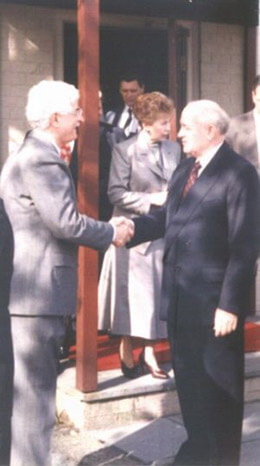
| In my return to the academic world after 17 years away from the academic world (those "nights on broadway" were hard to resist), I was teamed up at a conference of the International Society of Political Psychology (ISPP) with the Father of Political Psychology, Vamik Volkan (eventually to be nominated five times for a Noble Peace Prize). | |||
|
|||
|
My PhD is in (experimental) Social Psychology. The subtitle of my first book was entitled, "A Study in Psychoanalytic Sociology." But my first "home" when I returned to academia was the field of political psychology, a discipline just beginning to emerge in the late eighties. The first book exhibit I organized was at the 1988 meeting of the International Society of Political Psychology. At this meeting, I also participated in my first academic panel. I was teamed with Vamik Volkan, who was doing great things on the world stage. My first book Hitler's Ideology (available as an inexpensive ebook here) was conceived as a work of science (click through the link to see how—in the spirit of my doctoral training—my data was presented in tabular form). However, I mentioned in an early footnote that psychoanalytic sociology might serve as a "mode of social enlightenment—a means of bringing psychological insight to bear upon contemporary social phenomenon." Volkan's success in political psychology (he was eventually nominated five times for a Nobel Prize) encouraged me to move more strongly in an activist direction. Although I've never in my life engaged in political "protest," I thought my research and findings might play a role helping human beings to "awaken from the nightmare of history." Awakening might come about through understanding the "machinery of destruction and self-destruction"—the underlying desires, fantasies and fears that generate collective forms of destruction and self-destruction. |