|
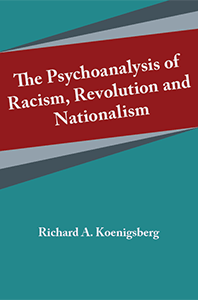
Richard Koenigsberg’s The Psychoanalysis of Racism, Revolution and Nationalism provides profound insight into the nature and meaning of nationalism, an ideology we often take for granted—so completely does it permeate our lives.
Praise
“A truly bold and provocative treatise: The nation is seen as the symbolic embodiment of a communal narcissistic ego, cleansed of the 'badness' introduced by a particular class of people within a nation's boundaries whose 'removal' by whatever means is easily rationalized if goodness is to be restored. The interpretations are intriguing and illuminating, the scholarship creative and careful.”
—Dan B. Thomas, Political Psychology (Journal).
“Koenigsberg identifies core phantasies underlying modern man's 'absolute faith in the reality of the nation.' According to nationalists' phantasy, one’s country is susceptible to disease, the source of which often is identified an alien class of people within the national body.
The nationalist cure to restore the narcissistic ego consists of an 'exorcism' that removes this group from within the sickly, decaying national body. Koenigsberg's argument possesses a relentlessly propositionally Euclidean quality. A remarkably sinewy work lays a secure foundation for future work.”
—Howard F. Stein, Canadian Review of Studies in Nationalism
|
Chapter II, Section 1: Racism and Revolution as a Wish to Eliminate the "Disease" from Within the Body of the Nation, from The Psychoanalysis of Racism, Revolution and Nationalism (Scroll down for Table of Contents)
An image commonly used among nationalists to describe the nation and communists to describe the party is that of the nation or party as a "living organism." Typically, Hitler: ”From a dead mechanism (the state) there must be formed a living organism.” Stalin stated that the communist party was a “living organism” that undergoes a process of metabolism: “the old and obsolete passes away, the new and growing lives and develops.”
Given this conception of the nation or party as an organism, there are a number of propositions that follow logically:
(1) The nation or party is susceptible to disease, to the possibility that germs, infections, cancers, etc., may invade its body, and cause it to become "ill." Mao said that self-criticism “prevents the inroads of germs and other organisms from contaminating the minds of our comrades and the body of our Party. We cannot) allow political germs to eat into our healthy organisms.”
(2) The source of the nation's disease may be a particular class of people lying within the body of the nation . Among anti-Semites, we find Lagarde describing Jews as “the carriers of decay who pollute every national culture . . . with trichinae and bacilli one does not negotiate . . . they are exterminated as quickly and as thoroughly as possible.”
And Hitler referring to Jews as people who “are suffering from a poisonous infection and who openly profess their desire to infect others with the same disease.”
While the French revolutionary Sieyes described the "privileged class" as “some horrible disease eating the living flesh on the body of some unfortunate man . . . (it) is a plague for the nation which suffers from it.”
(3) To achieve a "cure" for the disease, it may be necessary to "remove" a particular class of people from within the body of the nation, just as a surgeon removes a diseased part of the body whose continued existence is a threat to the survival of the organism. According to Lenin, the way of reform was the painfully slow decomposition of the putrid parts of the national organism, whereas the revolutionary was is the “quick amputation of the decomposing parts.”
Similarly, the justification of violence which appears in the writing of the Parisian Commune: "thus, the clever and helpful surgeon with his cruel and benevolent knife cuts off the gangrened limb in order to save the body of the sick man.”
Stalin’s assistant Dimitrov, described the purge of the mid-thirties in terms of the necessity of "cutting into good flesh in order to get rid of the bad."
What we encounter is a coherent phantasy, which may be summarized as follows: the nation is a living organism that is suffering from a "disease," whose source is a particular class of people lying within the body of a nation; to cure this disease, and thereby to "save the nation," it may be necessary to "remove" this class of people from within the body of the nation.
This phantasy is a fundamental source of acts of mass-destruction carried out in the name of political ideologies: the perpetrators think of themselves, not as murderers, but as men who have undertaken the "necessary task" of removing a disease element from within the body of the nation. They perpetrate acts of mass-destruction in the name of the purification of the narcissistic ego. Whether the target be the Jew, the capitalist, or a member of the ruling class, these men are "exorcists" who believe that the maintenance of the goodness of the nation can be achieved only through ''removal" of a certain class of persons from within the nation's boundaries.
|