Koenigsberg contra Foucault:
Does discourse shape the body, or does the body structure discourse?
For information on purchasing, The Psychoanalysis of Racism, Revolution and Nationalism (the eBook), please click here. |

Koenigsberg |
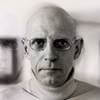
Foucault |
|
Foucault had it backwards. According to Koenigsberg, it is not so much that discourse shapes the body, but that the body is the source of and structures discourse:
- The “body politic” is not just a metaphor. This term expresses the fact that nations are experienced as if bodies. The idea of the body politic constitutes a projection of one's own body.
- Because nations are experienced in corporeal terms, they seek to secure their borders and orifices and entry points from infiltration, invasion and penetration. It's as if the outsider or alien is experienced as streaming into one's own body. Fear of anal rape.
- The experience of one’s nation with insecure or porous boundaries is equivalent to the fear that one’s own body will be penetrated. The body must be firmed up: a wall must be built to prevent one's body from being invaded by alien forces. A wall is a defense against the fear of penetration.
Hysteria and paranoia are fundamentally the same. Hysteria means that the alien object is experience as already within one's body (generating the desire to "eject" this object from within the boundaries of the self).
Paranoia means that the object is experienced as very close to the self, but still outside the body. The alien other must be fought--prevented from penetrated into the interior.
|
|