|
|
| The Islamic martyr gives his life and blood for Allah. Soldiers of the First World War gave their lives and blood for entities called “Russia,” “Germany,” “France” “Romania,” “Italy,” “Turkey”—and “the British Empire.” | |
| British Prime Minister David Lloyd George observed that during the First World War every nation was “profligate of its manpower" and conducted the war as if there were "no limit to the number of men fit to be thrown into the furnace to feed the flames of war.” The war was a perpetual, driving force that “shoved warm human hearts and bodies by the millions into the furnace.”
Some, however, viewed the slaughter in a positive light. P. H. Pearse—founder of the Irish Revolutionary movement—was thrilled by the carnage: The last sixteen months have been the most glorious in the history of Europe. Heroism has come back to the earth. It is good for the world to be warmed with the red wine of the battlefield. Such august homage was never before offered to God as this—the homage of millions of lives given gladly for love of country. In a similar vein, French nationalist Maurice Barrès said this about his nation's soldiers who were dying on a daily basis during the First World War: Oh you young men whose value is so much greater than ours! They love life, but even were they dead, France will be rebuilt from their souls which are like living stones. The sublime sun of youth sinks into the sea and becomes the dawn which will hereafter rise again. The death of a young man is sublime because it becomes the “dawn which will hereafter rise again.” Dead French soldiers regenerate the French nation. The First World War produced monumental destruction and massive numbers of casualties in the name of glorifying nations. Each nation proved its metal by sending young men to be slaughtered. The “greatest” nations were those that sent the largest number of men into the fray. However, many nations—not only great ones—wanted to be included. This is why we call it a “World War.” Nobody wanted to be left out (it's a family affair). White, Matthew — First World War Casualties Source: Historical Atlas of the Twentieth Century. 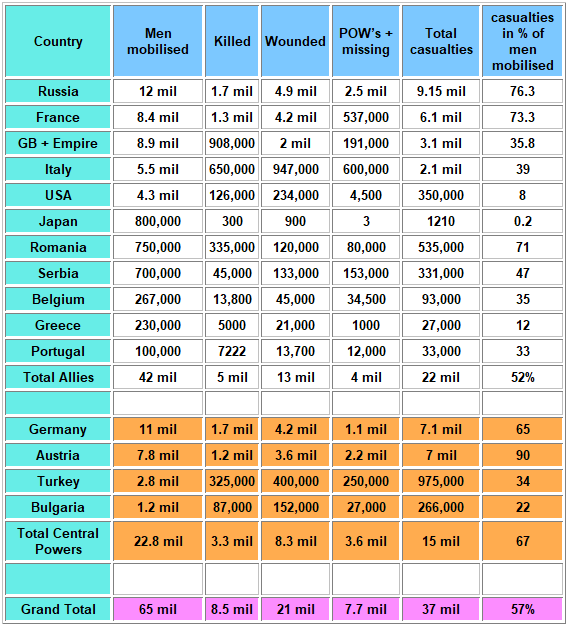 |