|
||
|
Some say that warfare reflects "male aggression;" or that the institution contains biological, evolutionary significance. Quite the contrary, warfare is one of the deepest expressions of human spirituality. Waging the First World War, human beings declared their devotion to a sacred object, the nation-state. World War I was a monumental, grotestque sacrificial competition—as each nation demonstrated its willingness to “gift” the lives of young men. Cultural creations convey the desires of human beings. What is the nature of the desire that generates warfare? The wish to demonstrate that there exists “another realm of being;” a domain of reality separate from mundane existence. Following wars, human beings create memorials, which testify to the existence of a transcendent realm. People believe that the prodigious killing and dying must have occurred for the sake of some thing. We find it difficult to imagine that the sound and fury occurred for no-thing. |
||
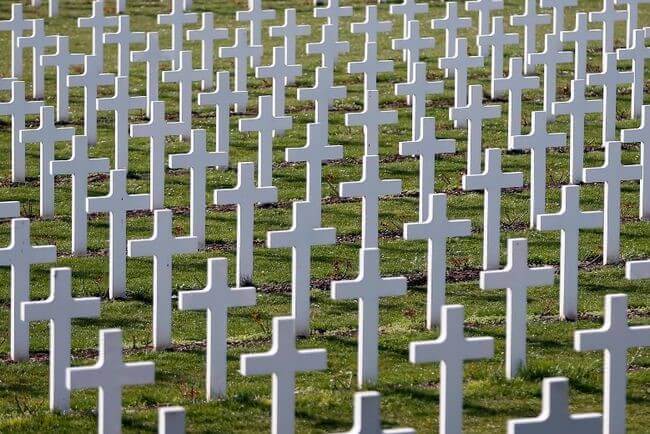
The First World War reached its conclusion—not when the last machine guns had been fired nor when the artillery guns rested. The conclusion of the war was the memorials erected to honor soldiers that had died. These crosses represent proof that young men had devoted themselves—given their lives—for their nations. They affirm the reality of a transcendent domain—separate from ordinary existence. During the First World War, each nation asserted the reality of its own sacred object, asserted its superiority—demonstrating the depth of its devotion—by virtue of its willingness to gift young men. The war ended—not because one side had “defeated” the other—but when one side ran out of sacrificial victims. |