|
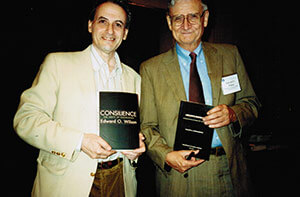 Richard Koenigsberg and
Edward O. Wilson
Ideologies become central within a society because they allow fantasies to be expressed, articulated and enacted. They are containers for shared fantasies, driving the historical process. Where Freud interpreted individual dreams and dreaming, I interpret collective dreams and dreaming. This is what I mean by making conscious the unconscious in social reality.
The Nazi revolution constituted the enactment of a dream that many people were having at the same time—a shared fantasy powerful enough to give rise to an ideology and social movement. Dreaming this dream most deeply, Hitler was able to articulate the Nazi fantasy. To know why Nazism achieved popularity, we need to determine precisely what Hitler said that caused Germans to rise to their feet and shout "Heil Hitler."
|
In Constitutional Law of the Third Reich, Nazi political theorist Ernst Rudolf Huber wrote:
The Fuhrer is the bearer of the collective will of the people. In his will the will of the people is realized. His will is not the subjective will of a single man, but the collective national will is embodied within him in all its objective, historical greatness.
The people's collective will has its foundation in the political idea which is given to a people. It is present in the people, but the Fuhrer raises it to consciousness and discloses it. (in Murphy 1943)
The will of a people, Huber suggests, grows out a political idea which is “present in the people.” However, the Fuehrer is “raises this idea into consciousness;" to discloses it.”
Once an idea has become conscious within a people, what follows is the will to enact it: to turn the idea into reality. The leader’s role is to invent ways to activate the people’s collective will, and to define a path--a series of actions--that permits the collective will to manifest as social reality.
I theorize that ideology represents or reflects a fantasy that is shared by members of a society. This shared fantasy lies at the core—constitutes the heart and soul—of a given culture. The leader’s role is to “divine” the cultural fantasy: give it voice.
To have a significant impact, the leader himself must be deeply mindful of his culture's fantasies. He processes the fantasies as they exist within himself, then finds ways to present or "return" the fantasy to his people. The ideology becomes the container for a people’s shared fantasies.
Why was Hitler able to hold his audiences spellbound? Why did Germans become so excited when he spoke? Because what he said evoked something deep within many of them. People were “turned on” by Hitler’s words.
We are on the wrong track if we imagine that ideas put forth by political leaders contain, or are intended to contain, some form of “truth:” that they correspond to “external reality.” The coin of the realm in politics is fantasy: the leader’s ability to express his own fantasies, and to induce or seduce others to share these fantasies. The leader presents ideas that resonate with his audience. His utterances allow followers to externalize inner states of being.
Highly successful leaders are deeply plugged into the ideological fantasies that they put forth. No one was more moved by Hitler’s ideas more than Hitler himself. By virtue of his ability to share his excitement and passion, he was able to evoke a similar experience within his followers.
Ideologies function to express, contain and engage the fantasies of members of society. The ideology functions as a modus operandi: a vehicle allowing a shared fantasy to make its way into reality (man in culture, Norman O. Brown said, is “Man dreaming while awake”). They act as a gravitational force, “pulling” fantasies into the world—capturing or sequestering the energy bound to a fantasy.
Political history occurs when a group acts upon an ideological fantasy. Hitler worked to transform his fantasy of Germany into a societal discourse. His will was the will to persuade the German people to actualize propositions contained within the ideological fantasy.
Each ideology revolves around a core fantasy that constitutes the heart and soul of the ideology: a sublime or omnipotent object. History is generated in the name of these objects. For the Nazis, the omnipotent object was “Germany.” Japan fought the Second World War for the sake of “the Emperor.” The United States participated in the First and Second World Wars for “freedom and democracy.” While radical Islamic movements revolve around “Allah.”
Historians study the “reasons” why violent political conflicts arise at a particular moment in history. But for action to be undertaken at all, there must be a core fantasy—an omnipotent object. Without “Germany” or “the Emperor” or “freedom and democracy,” there could not have been a Second World War.
To understand a particular ideology is to uncover and reveal the core fantasy. In the case of Nazism, this fantasy revolved around the idea of Germany as an actual body (politic) suffering from a potentially fatal disease, the source of which was the Jew. Hitler put himself forward as “doctor” of the German people, the man who could root out and destroy the cause of Germany’s suffering, thereby rescuing the nation and saving it from death.
For any ideology, one may pose and seek to answer the question: Why does this ideology exist?
- What fantasy or set of fantasies does the ideology contain or convey?
- What methods are used by the leader to encourage members of his society to believe in and to act upon the ideological fantasy?
- Why are followers willing to perform violent acts in the name of the ideological fantasy?
- What do leaders and followers hope to achieve by acting upon their society’s ideological fantasy?
Ideologies constitute modus operandi for the expression and enactment of shared fantasies. They become central within a society precisely because they allow unconscious fantasies to be expressed and articulated. They are containers for shared fantasies, driving the historical process. Unconscious fantasies enter history through ideologies.
Where Freud interpreted individual dreams and dreaming, I interpret collective dreams and dreaming, seeking to ascertain latent thoughts beneath manifest content. This is what I mean when I speak of “making conscious the unconscious in social reality.”
The Nazi revolution constituted the enactment of a dream that many people were having at the same time—a shared fantasy powerful enough to give rise to an ideology and social movement. Dreaming this dream most deeply, Hitler was able to articulate the Nazi fantasy. To know why Nazism achieved popularity, one needs to determine precisely what Hitler said that caused Germans to rise to their feet and shout "Heil Hitler."
I theorize that a necessary condition for the espousal of an ideology within a society is the existence of an unconscious fantasy shared by group members. The ideology is the cultural creation or invention that permits a shared fantasy to manifest as social reality.
It is through the medium of an ideology that a shared fantasy becomes part of the world. An ideology is believed, embraced and perpetuated—achieves status and power as an element of culture—insofar as it resonates with a fantasy and permits this fantasy to be activated upon the stage of society.
|