CALL FOR A REVIEW ESSAY:
Putting Liberalism in Its Place
Paul W. Kahn |
Because of his quiet, measured style of presentation, it is perhaps difficult to recognize Paul W. Kahn as one of our most radical social theorists. Excerpts from Putting Liberalism in its Place appear below. We seek an author to write a review essay on Kahn’s profound study. Please respond directly to this email, or write to oanderson@libraryofsocialscience.com
Library of Social Science Book Reviews is the premier website publishing and promoting substantial review essays of scholarly books. For information on LSS Book Reviews, please click here. Parameters for an LSS review essay are directly below.
|
Putting Liberalism in Its Place
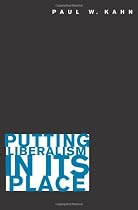 |
Publisher: Princeton U. Press
Author: Paul W. Kahn
ISBN: 069113698X
Pages: 336
Format: Paperback |
In this wide-ranging interdisciplinary work, Paul W. Kahn argues that political order is founded not on contract but on sacrifice. Because liberalism is blind to sacrifice, it is unable to explain how the modern state has brought us to both the rule of law and the edge of nuclear annihilation. We can understand this modern condition only by recognizing that any political community, even a liberal one, is bound together by faith, love, and identity.
Praise
"[This] is a beautifully written meditation on the sources of political meaning that cannot be justified by rational argumentation. It challenges the reader to acknowledge that politics is a fundamentally amoral enterprise that resembles romantic love more than rational debate."—Margaret Kohn, Political Theory
About the author
 Paul W. Kahn is the Robert W. Winner Professor of Law and the Humanities at Yale Law School and the Director of the Orville H. Schell, Jr. Center for International Human Rights.
For information on purchasing this book directly from Princeton University Press, please click here.
Library of Social Science works with Princeton University Press to promote its titles at book exhibits throughout the United States. For additional information on Library of Social Science Book Exhibits please scroll to the bottom of the page. |
|
|
LIBERAL FAILURE TO RECOGNIZE
THE RELIGIOUS CHARACTER OF THE NATION-STATE
The twentieth century can only be judged a secular age if we take a narrow view of religion. If we understand religious experience as the discovery of ultimate meaning, then the century was marked by the magnitude of its faith, and even by the extreme character of the sacrificial demand made by political communities of ultimate belief.
Western nation-states became grand institutional structures for the sacrifice of their citizens to the idea of the necessity of the state’s continued existence. Only under such an idea can we begin to make sense of the millions sacrificed on the battlefields of Europe, let alone the extension of the battlefield to the entire territory of the state. The modern state coopts the act of sacrifice to its own ultimate end, which is only the continued existence of the popular sovereign.
Failure to recognize the quasi-religious character of the modern nation-state as the context within which liberalism operates is the single largest failure of liberal political theorists. Reading them, one would never know that the modern nation-state has been the site of endless passion and of sacrifice for the ultimate meanings. For them, the people appear only as a decision-making device—majority rule—in a world stripped of ultimate meanings. To the liberal theorists, the passion of politics appears always as a dangerous outbreak of archaic forms of belief and practice. History must, therefore, be a story of progress away from the very conditions that generate history. Indeed, the ideal theory of the state is to help us to escape history.
No matter how large or important the private domain becomes, the modern nation-state always claims the authority to transgress the border of the private and to devote all of the available resources—physical, material, and personal—to the state’s vital interests. The bourgeois is also the citizen, and the citizen exists his entire life with the understanding that he and his property may be conscripted, that is, literally made into an instrument of the state. |
“THE PEOPLE” AS THE MYSTICAL BODY OF CHRIST
The kings of Europe took on the symbolic character of the body of Christ: they too had overcome death in their own bodies. And just as the body of Christ is the body of the church, so the body of the King is the mystical corpus of the state. The political story of the rise of the modern West is that of the transformation of the sovereign as the monarch to the sovereign as the people. The will of the people becomes the source of legal order: the popular sovereign—not the monarch’s body—is the mystical corpus of the state. It too conquers the death of the finite body. Only the locus of sovereignty, not its symbolic character changes.
By the modern era, the people have become the new absolute. The people as a single subject are the source of ultimate meanings in and for the Western state. Rousseau tells us that the sovereign people are infallible; they are also deathless. All legitimate political power in the nation-state is now conceived as a representation of the sovereign people. The sole warrant for political power is a claim to represent the people. The people have become the new god and their state founds the new world order.
The modern nation-state has definitively established itself when government asserts that it is entitled to demand of every citizen that he or she sacrifice the self for the continued existence of the state. This demand appears legitimate because individual identity has been reconceived as membership in the popular sovereign. We are all citizens and comrades. Ultimate meanings coincide with ultimate demands. The reverse side of this is that entire populations, as political communities, can become the target of attack.
|
PORNOGRAPHIC REBELLION
Pornography is a fantasy of freedom and as such should be contrasted not only with historicized readings of the body but also with that other powerful fantasy of freedom from the body that operates in the West: the ascetic tradition within Christianity. Our imaginations—fictional and acted out—record numerous instances in which these fantasies coincide. The Christian ascetics’ withdrawal of the self from the full range of our ordinary commitments—familial, communal, and political—always threatens to leave him or her in a thrall to the pornographic.
The claim that the body is nothing at all easily becomes a claim that the body is all that there is. The pornographic is the ecstatic moment shorn of religion. The sacred too can displace ordinary forms of language. In both, we are rendered speechless, without even that most rudimentary form of speech—our own name. But if we push beyond the negative, superliberal critique, and look for [Foucault’s] positive account of freedom, we find a turn to the body seen through the prism of the pornographic imagination.
The pornographic/romantic is always a rebellion, taking back of the body from the symbolic labor of love. The pornographic/romantic sets at naught all efforts at ordered social construction, wherever they might appear. Eros, on this view, takes us over and in so doing takes us out of our ordinary lives. It is a kind of madness. To this mad soul, state and family appear as a kind of death. For this reason, the pornographic will always be seen by the state as an act of political rebellion. It is no less, because it is a reclaiming of the self from all of these attachments. State and family will accordingly make a common alliance against the pornographic. This is the politics of “family values.”
|
 Princeton University Press’ titles at the Society for the Advancement of Socio-Economics conference in Chicago, July 10-13. |
Library of Social Science is the premier book exhibit company creating, organizing and managing book exhibits for scholarly and professional conferences. We work with the major publishers of scholarly books to develop exhibits of unsurpassed quality at cutting edge conferences. Among the publishers we work with is Princeton University Press.
We have exhibited and promoted Princeton U. Press titles at the following 2014 conferences:
- American Ethnological Society
- Asian Studies Development Program
- ASIANetwork
- Cheiron: The International Society for the History of Behavioral & Social Sciences
- Society for the Advancement of Socio-Economics
- Southwestern Psychological Association
- Thinking Publicly
|
PARAMETERS OF A LIBRARY OF SOCIAL SCIENCE BOOK REVIEW ESSAY
- Essays will be written in the spirit of the LSS Mission Statement that appears here.
- Essays should be approximately 3,000 words in length (for a sample essay, click here).
- Essays are to be completed no later than three months after receipt of the book.
- Beginning with the text, reviewers may focus on important issues in order to present and develop their own views and theories on the topics treated.
- Reviews will be edited by the staff of Library of Social Science.
- Reviews will be announced through the Library of Social Science Newsletter, which reaches over 60,481 people in the U.S. and around the world.
- With each review, LSS will promote a book authored by the reviewer (and/or will publicize an author event).
- LSS reserves the right to decline publication of any review.
|
|
|
|
|
|