 |
Publisher: Routledge
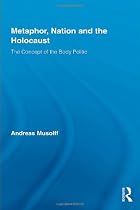
Author: Andreas Musolff
Format: Hardcover
ISBN-10 0415801192
ISBN-13 978-0415801195
Pages: 220 |
This book provides a cognitive analysis of the function of biological/medical metaphors in National Socialist racist ideology and their background in historical traditions of Western political theory. Its main arguments are that the metaphor of the German nation as a body that needed to be rescued from a deadly poison must be viewed as the conceptual basis rather than a mere propagandistic by-product of Nazi genocidal policies culminating in the Holocaust; and that this metaphor is closely related to the more general metaphor complex of the nation as a human body/person, which is deeply ingrained in Western political thought.
About the Author
Andreas Musolff is a Professor in the School of Language and Communication Studies at the University of East Anglia, UK. |
LIBRARY OF SOCIAL SCIENCE BOOK REVIEWS identifies significant titles and promotes them through substantive review essays written by top scholars. Our reviews are thoughtful commentaries engaging a book’s arguments and articulating the implications of its ideas. Library of Social Science provides a space of freedom, allowing scholars to challenge conventional approaches, develop new theories, and present original ideas. |
|
|
“How does a metaphor in political communication impact people’s perception and behavior—even turning them into perpetrators of genocide?” This is the question posed by Andreas Musolff’s Metaphor, Nation and the Holocaust.
The genocidal policy that culminated in the Holocaust, Musolff demonstrates, was grounded on the metaphor of Germany as an actual body, and Jews as “agents of disease”: parasites that threatened the nation’s health, and which therefore had to be annihilated. The “infectious disease” metaphor suggested that complete destruction of the agent of illness was envisaged—“otherwise the infection would not be eradicated.”
|
We seek reviewers for Metaphor, Nation
and
the Holocaust. Reply directly to this email,
or to
Orion Anderson at oanderson@libraryofsocialscience.com
Review essays will be distributed to over 72,220 people around the world through the Library of Social Science Newsletter. With each review published, LSS will promote and sell a book authored by the reviewer (and/or will publicize an author event, lecture, etc.).
Please read the Benefits of Authoring an LSS Review Essay (below). |
The denunciation of a group of people as parasites, and one’s nation as a body in danger of perishing, Musolff observes, were not vague or abstract descriptions, but striking and spectacular. Moreover, they were “applied in a horrifically ‘literal’ sense by trying to physically eliminate the Jewish people.” We should not regard Hitler’s metaphors merely as metaphors: “for him, they described reality.”
On the one hand, Musolff says, Hitler’s beliefs were “absolutely fantastical,” the sort that ordinarily “only madmen have” (Goldhagen). On the other hand, once one accepts Hitler’s premise that there is such a thing as a national body, and that this body has fallen ill, “the need to find a cure appears uncontroversial, and so does the necessity to destroy the parasite that has caused the illness.”
Musolff raises the fundamental question at the heart of the Holocaust: “How could a worldview based on the mapping of bio-medical onto socio-political concepts becomes so powerful and be taken so seriously that it turned into the reality of genocide and world war?”
|
BENEFITS OF AUTHORING AN LSS REVIEW ESSAY
- Reviewers reach, and interact with a group of scholars who research and write about similar topics. You become part of an ongoing dialogue as we forge a community including some of the world’s best scholars.
- Review essays may be at least 2,000 and up to 6,000 words in length. This provides a unique opportunity to go beyond the conventional review: to convey one’s own ideas and research, as well as to incorporate findings from other publications.
- With each book reviewed, we promote and publicize a book (or dissertation, or paper) authored by the reviewer. While we are promoting and selling the book under review, we simultaneously promote and sell the reviewer’s book.
|
|
THE TITLES BELOW WERE RECENTLY REVIEWED
To read any of these review essays, simply click the button
below entitled "Read the Complete Review Essay."
Note: when we distribute and promote a review, we also promote and sell a book authored by the reviewer (titles on the left were reviewed; books on the right are by authors of the review). |
| Book Reviewed |
Read the Complete Review Essay |
Publication by Reviewer |
 |
Stanley Hauerwas
War and the American Difference |
 |
War and the American Difference
Stanley Hauerwas is the Gilbert T. Rowe Emeritus Professor of Theological Ethics at Duke University in Durham, NC.
Rev. Kelly Denton-Borhaug, is Associate Professor of Religious Studies at Moravian College.
 |
 |
Kelly Denton-Borhaug
U.S. War-Culture, Sacrifice and Salvation |
|
 |
André Mineau
SS Thinking and the Holocaust |
|
SS Thinking and the Holocaust
André Mineau is Professor of Ethics and History at the University of Quebec at Rimouski.
Brian Crim is Associate Professor of History at Lynchburg College.
|
Brian Crim’s Antisemitism in the German Military Community and the Jewish Response, 1914-1938 is forthcoming from Lexington Books in 2014.
|
|
 |
Eric Weitz
A Century of Genocide |
|
A Century of Genocide
Eric D. Weitz is Dean of Humanities and Arts and Professor of History at The City College of New York.
Murray Schwartz teaches Shakespeare, Holocaust Literature and Literature and Psychoanalysis at Emerson College in Boston.
|
 |
Murray Schwartz
The Dance Claimed Me
|
|
 |
Laura Wittman
The Tomb of the Unknown Soldier |
|
The Tomb of the Unknown Soldier
Laura Wittman is Associate Professor of French and Italian at Stanford University.
Roger Griffin is professor in Modern History at Oxford Brookes University.
|
 |
Roger Griffin
Modernism and Fascism
|
|
 |
Mark Schantz
Awaiting the Heavenly Country |
|
Awaiting the Heavenly Country
Mark S. Schantz is Professor of History and Director of the Odyssey Program at Hendrix College.
Rana Salimi received her Ph.D from UC San Diego, department of Theater and Dance, and currently lectures at UC San Diego and National University.
|
| Rana Salimi’s doctoral dissertation, "Visual Representation of Palestinian Female Martyrs Inside and Outside of Muslim Culture", deals with the issue of self-sacrifice for a higher cause. |
|
|
|
Call for Review Essay
Metaphor, Nation and the Holocaust: The Concept of the Body Politic
by Andreas Musolff (Published by Routledge) |
|
Publisher: Routledge
Author: Andreas Musolff
Format: Hardcover
ISBN-10 0415801192
ISBN-13 978-0415801195
Pages: 220 |
This book provides a cognitive analysis of the function of biological/medical metaphors in National Socialist racist ideology and their background in historical traditions of Western political theory. Its main arguments are that the metaphor of the German nation as a body that needed to be rescued from a deadly poison must be viewed as the conceptual basis rather than a mere propagandistic by-product of Nazi genocidal policies culminating in the Holocaust; and that this metaphor is closely related to the more general metaphor complex of the nation as a human body/person, which is deeply ingrained in Western political thought.
About the Author
Andreas Musolff is a Professor in the School of Language and Communication Studies at the University of East Anglia, UK. |
LIBRARY OF SOCIAL SCIENCE BOOK REVIEWS identifies significant titles and promotes them through substantive review essays written by top scholars. Our reviews are thoughtful commentaries engaging a book’s arguments and articulating the implications of its ideas. Library of Social Science provides a space of freedom, allowing scholars to challenge conventional approaches, develop new theories, and present original ideas. |
|
|
“How does a metaphor in political communication impact people’s perception and behavior—even turning them into perpetrators of genocide?” This is the question posed by Andreas Musolff’s Metaphor, Nation and the Holocaust.
The genocidal policy that culminated in the Holocaust, Musolff demonstrates, was grounded on the metaphor of Germany as an actual body, and Jews as “agents of disease”: parasites that threatened the nation’s health, and which therefore had to be annihilated. The “infectious disease” metaphor suggested that complete destruction of the agent of illness was envisaged—“otherwise the infection would not be eradicated.”
|
We seek reviewers for Metaphor, Nation
and
the Holocaust. Reply directly to this email,
or to
Orion Anderson at oanderson@libraryofsocialscience.com
Review essays will be distributed to over 72,220 people around the world through the Library of Social Science Newsletter. With each review published, LSS will promote and sell a book authored by the reviewer (and/or will publicize an author event, lecture, etc.).
Please read the Benefits of Authoring an LSS Review Essay (below). |
The denunciation of a group of people as parasites, and one’s nation as a body in danger of perishing, Musolff observes, were not vague or abstract descriptions, but striking and spectacular. Moreover, they were “applied in a horrifically ‘literal’ sense by trying to physically eliminate the Jewish people.” We should not regard Hitler’s metaphors merely as metaphors: “for him, they described reality.”
On the one hand, Musolff says, Hitler’s beliefs were “absolutely fantastical,” the sort that ordinarily “only madmen have” (Goldhagen). On the other hand, once one accepts Hitler’s premise that there is such a thing as a national body, and that this body has fallen ill, “the need to find a cure appears uncontroversial, and so does the necessity to destroy the parasite that has caused the illness.”
Musolff raises the fundamental question at the heart of the Holocaust: “How could a worldview based on the mapping of bio-medical onto socio-political concepts becomes so powerful and be taken so seriously that it turned into the reality of genocide and world war?”
|
BENEFITS OF AUTHORING AN LSS REVIEW ESSAY
- Reviewers reach, and interact with a group of scholars who research and write about similar topics. You become part of an ongoing dialogue as we forge a community including some of the world’s best scholars.
- Review essays may be at least 2,000 and up to 6,000 words in length. This provides a unique opportunity to go beyond the conventional review: to convey one’s own ideas and research, as well as to incorporate findings from other publications.
- With each book reviewed, we promote and publicize a book (or dissertation, or paper) authored by the reviewer. While we are promoting and selling the book under review, we simultaneously promote and sell the reviewer’s book.
|
|
THE TITLES BELOW WERE RECENTLY REVIEWED
To read any of these review essays, simply click the button
below entitled "Read the Complete Review Essay."
Note: when we distribute and promote a review, we also promote and sell a book authored by the reviewer (titles on the left were reviewed; books on the right are by authors of the review). |
| Book Reviewed |
Read the Complete Review Essay |
Publication by Reviewer |
|
Stanley Hauerwas
War and the American Difference |
|
War and the American Difference
Stanley Hauerwas is the Gilbert T. Rowe Emeritus Professor of Theological Ethics at Duke University in Durham, NC.
Rev. Kelly Denton-Borhaug, is Associate Professor of Religious Studies at Moravian College.
|
|
Kelly Denton-Borhaug
U.S. War-Culture, Sacrifice and Salvation |
|
|
André Mineau
SS Thinking and the Holocaust |
|
SS Thinking and the Holocaust
André Mineau is Professor of Ethics and History at the University of Quebec at Rimouski.
Brian Crim is Associate Professor of History at Lynchburg College.
|
Brian Crim’s Antisemitism in the German Military Community and the Jewish Response, 1914-1938 is forthcoming from Lexington Books in 2014.
|
|
|
Eric Weitz
A Century of Genocide |
|
A Century of Genocide
Eric D. Weitz is Dean of Humanities and Arts and Professor of History at The City College of New York.
Murray Schwartz teaches Shakespeare, Holocaust Literature and Literature and Psychoanalysis at Emerson College in Boston.
|
|
Murray Schwartz
The Dance Claimed Me
|
|
|
Laura Wittman
The Tomb of the Unknown Soldier |
|
The Tomb of the Unknown Soldier
Laura Wittman is Associate Professor of French and Italian at Stanford University.
Roger Griffin is professor in Modern History at Oxford Brookes University.
|
|
Roger Griffin
Modernism and Fascism
|
|
|
Mark Schantz
Awaiting the Heavenly Country |
|
Awaiting the Heavenly Country
Mark S. Schantz is Professor of History and Director of the Odyssey Program at Hendrix College.
Rana Salimi received her Ph.D from UC San Diego, department of Theater and Dance, and currently lectures at UC San Diego and National University.
|
| Rana Salimi’s doctoral dissertation, "Visual Representation of Palestinian Female Martyrs Inside and Outside of Muslim Culture", deals with the issue of self-sacrifice for a higher cause. |
|
|
|
|
|
|
|
|
|