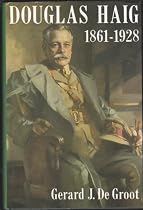
|
Publisher:
Unwin Hyman
Author:
Gerard J. DeGroot
Format: Paperback
ISBN-10: 0044401922
Language: English
Pages: 496 |
This biography of the First World War general, Sir Douglas Haig, counters the polarized views of Haig as either the butcher of the Somme or the saviour of Britain. To construct a more complete picture of his early life and career, usually neglected in favour of his wartime activities, the author draws on eight years of research into previously neglected sources as well as readily available material to reveal a man who, in his opinion, mirrored both the virtues and the flaws of Edwardian Britain, and whose misfortune it was to grow up in one age and to command in another. |
|
Dear Colleague,
Book reviews soon to be published by Library of Social Science on Mark Schantz’s book, Awaiting the Heavenly Country, will examine the meanings of the “suicidal charges” that characterized the Civil War from start to finish. Why did men slaughter each other so promiscuously—with a “zeal we still grope to understand”?
We would appreciate your comments on
this Newsletter.
Please leave your reflections and commentary on our blog. |
I’m not an expert on the Civil War. However, I’ve been studying the First World War for 25 years—another conflict characterized by suicidal battle tactics. Having read hundreds of books and written thousands of pages on this topic, the fundamental question—the one I sought to answer when I began this research—remains:
Why did leaders of civilized nations ask young men—for four years—to get out of trenches to be mowed down by machine gun fire and artillery shells? Why did these young men continue to obey orders—for four years—to go “like sheep to the slaughter,” resulting in 37 million casualties?
For a brief period (1992-2000), it seemed that the human race had reached the end of history; that there was nothing to kill and die for. Quite apart from the politics of September 11, 2001, the suicide bombers brought back into consciousness the idea that some human beings are willing to die in the name of a value or ideal considered to be sacred. Since most of us do not worship Allah, the event seemed “incomprehensible.”
Field Marshall Douglas Haig was a British senior officer during World War I who commanded the British army from 1915 to the end of the war. He directed the Battle of the Somme (July 1 to November 18, 1916), in which more than one million men were wounded or killed, making it one of the bloodiest battles in human history. The first day of fighting resulted in 60,000 casualties, the worst day in the British army’s history.
Visiting the battlefield on March 31, 1917, Haig reflected that credit had to be paid to the splendid young officers who were able to attack again and again. “To many,” Haig stated, “it meant certain death, and all must have known that before they started.”
We would appreciate your comments on
this Newsletter.
Please leave your reflections and commentary on our blog. |
Apart from questions of ideology, historical context and tactics, what Haig says about British soldiers could be said by a radical Islamic leader speaking about men he had sent to perform a suicide bombing: “It meant certain death, and they knew it from the beginning.”
What’s more, to my astonishment, Haig justified the fatalities he caused by citing a Muslim military leader, Mughal Emperor Babur (1483-1530) whose views on “heroic death”, he said, are “curiously appropriate now”:
“The most high God has been propitious to us: If we fall in the field, we die the death of martyrs. If we survive, we rise victorious the avengers of the cause of God.” |
This statement, Haig said, gets at the “root matter of the present war.”
So there it is: Haig conceptualizes the fatalities of the First World War in a manner identical to how a Muslim warrior conceptualizes death on the battlefield: either one is victorious (with God on one’s side), or one dies a martyr (and presumably rises to paradise or heaven).
In his report of August 22, 1919, Features of the War, Haig states that total British casualties in all theaters of war—killed, wounded, missing and prisoners (including native troops)—were approximately three million (3,076,388). He claims that these casualties were “no larger than to be expected.”
Indeed, according to Haig, British casualties were worth the cost because the issues involved in the stupendous struggle were “far greater than those concerned in any war in recent history.” In the First World War, “Civilization itself was at stake.”
While many of us find the actions of suicide bombers to be incomprehensible, we take for granted the behavior of soldiers in the First World War—who acted like suicide bombers—running into machine gun fire and artillery shelling—martyring themselves for a god given the name of “Great Britain.”
I pose the question: Why do we not find the behavior of leaders and soldiers during the First World War to be incomprehensible? Why are we blasé in our acceptance of the radical behavior that characterized this war? Because it is “written up in history books”? We accept the slaughter as natural, even normal, because the slaughter was undertaken in the name of gods in which we continue to believe.
What would it mean if we could distance—alienate—ourselves from our history: view it from outside the framework of our own belief system? What if we abandoned our faith in the “goodness” of society? What if we no longer worshipped “nations”? What if we allow ourselves to acknowledge—become aware of—the monumental, profound pathology that lies at the heart of civilization?
We would appreciate your comments on
this Newsletter.
Please leave your reflections and commentary on our blog. |
Best regards,
Richard Koenigsberg
|
